

Stress can make a normal Wednesday feel like your nervous system got copied on a five-alarm emergency. Your chest tightens, your thoughts sprint, and even a mildly rude email starts feeling like a personal attack from the universe.
That is where EFT tapping can help. It is simple, a little odd-looking at first, and often easier than trying to meditate while your brain is doing wind sprints. Let’s make it plain, grounded, and usable.
What EFT tapping is, in normal human language
EFT stands for Emotional Freedom Technique. Most people call it tapping. You lightly tap on a set of body points while focusing on a stressful thought, feeling, or situation.
That is the whole basic idea.
It is not magic, and it is not a cure-all. It is also not as airy as it can sound online. Tapping blends a few things that already make sense together, focused attention, a bit of exposure to what is bothering you, calming physical rhythm, and words that help you name what is real.
For a lot of people, that combination feels easier than sitting perfectly still and trying to “clear the mind.” When stress is high, silence can feel like being trapped in a room with your loudest thoughts. Tapping gives the mind a job and the body a rhythm. Sometimes that is enough to create space.
If you have read Abraham Hicks, this will sound familiar in a grounded way. Even if that’s not your usual reading material, the logic holds up: stress is often just an internal tug-of-war. You want peace, but your thoughts keep arguing. You want relief, but your body is braced. It is like pressing the gas pedal and the brake at the same time.
Tapping can soften that friction.
The research is still developing, but interest in EFT has grown because many people report feeling calmer after using it. WebMD’s overview of EFT tapping gives a straightforward summary of how people use it for stress and anxiety. You can do EFT on your own, or with a practitioner if you want more support.
If “alignment” language works for you, think of tapping as a small way back toward it. If that word makes your eyes glaze over, fair enough. Think of it as interrupting emotional momentum before one hard moment turns into a whole miserable afternoon.
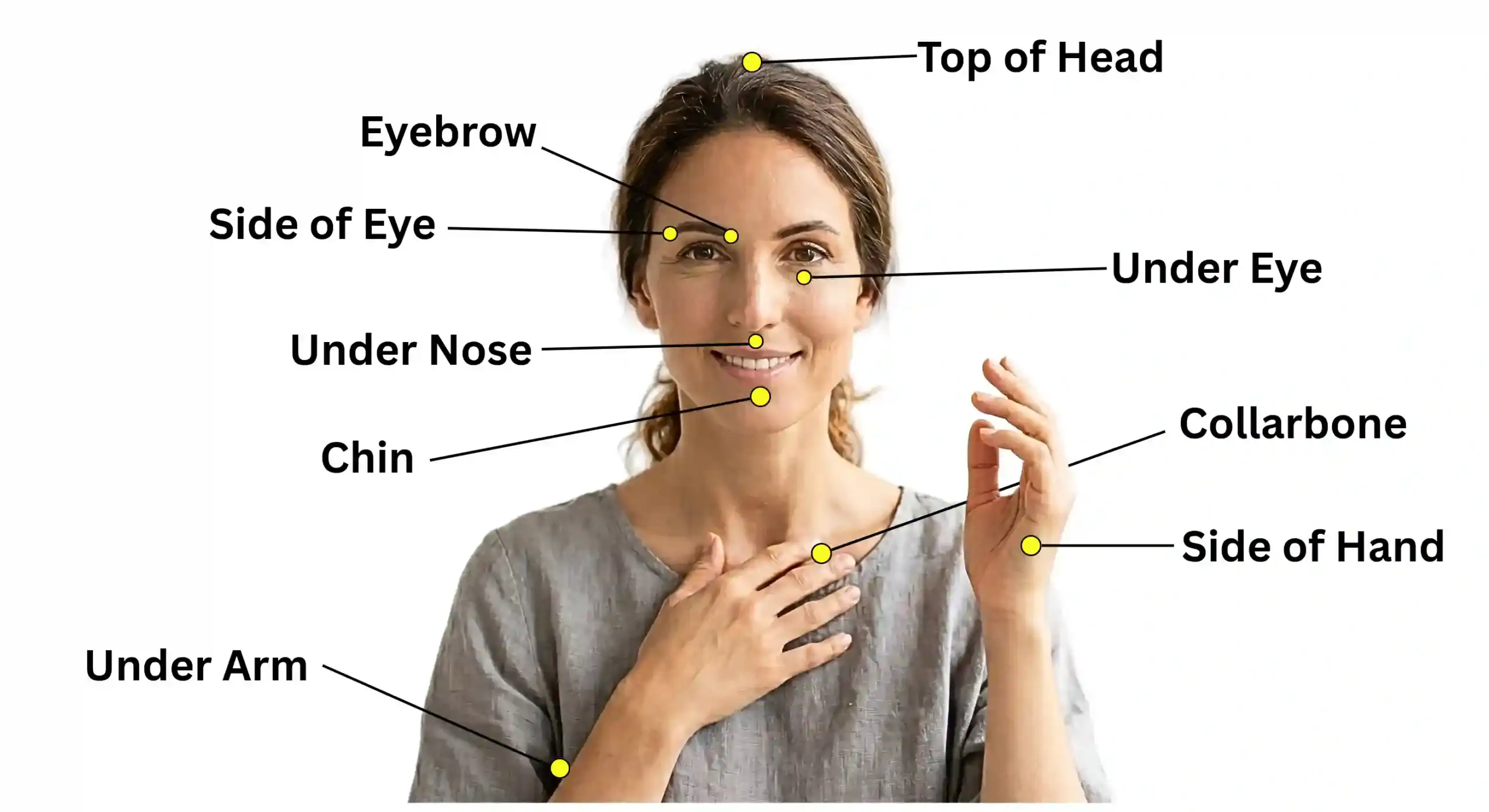
A simple tapping routine for everyday stress relief
You do not need a perfect script, a perfect mood, or a perfect memory of the tapping points. You only need a few minutes and enough willingness to try something that may feel slightly weird for about 90 seconds.
Try this when you feel wired, overwhelmed, irritated, or stuck in a thought loop. And if racing thoughts show up at bedtime, a dedicated EFT sleep tapping routine can help you wind down instead of replaying your whole day.
- Start by naming the stress. Keep it specific. “I am overwhelmed” works. “This meeting is making my stomach clench” is even better.
- Rate the intensity from 0 to 10. You are not grading yourself. You are just noticing where you are right now.
- Tap the side of one hand, sometimes called the karate chop point, while saying a setup phrase three times. Try: “Even though I feel stressed about this meeting, I accept how I feel right now.” If “accept” feels too lofty, use “I am here with how I feel right now.”
- Tap through the common points while using a short reminder phrase. A beginner-friendly sequence is eyebrow, side of eye, under eye, under nose, chin, collarbone, under arm, and top of head. Tap each point about 5 to 7 times while saying something simple like, “This stress in my body,” or, “All this pressure.”
- Pause and take one slow breath. Then notice what has changed. Maybe the number dropped from 8 to 6. Maybe the stress moved from your chest to your jaw. That still counts.
- Do another round if you want. This time, follow what feels true. “I still feel tense.” “I am annoyed.” “Part of me wants this to stop.” Honest words work better than polished ones.
If you only remember one point, use the collarbone. (Seriously, it’s the overachiever of the tapping points.) If you want the complete sequence in its traditional order, see The 9 EFT Tapping Points in Their Traditional Order.
If you only remember one rule, make it this one: say what is real. The goal is not to perform calm. The goal is to give your body a chance to soften – to feel your shoulders physically drop an inch, or notice your jaw finally unclench.

How to get better results without forcing it
The biggest shift with tapping is this, you are not trying to jump from panic to bliss in one dramatic leap. That usually backfires. A slightly softer thought is enough. A little more space in the chest is enough. A two-point drop on your stress scale is enough.
Aim for a little less tension, not instant enlightenment.
That matters because emotional momentum is real. One stressful moment can pull five more behind it. A curt text becomes a whole mental documentary about how everything is falling apart and maybe you should disappear into a cabin. Tapping helps interrupt that pile-on while it is still small enough to catch.
It also helps to start with what is true, not what sounds noble. If your actual thought is, “I hate how activated I feel,” use that. You can always soften later. Trying to force positive language too soon often adds more resistance, and your nervous system notices.
A few small habits make tapping easier to stick with:
- Use it early, when you first feel the spiral starting.
- Keep your phrasing plain and specific.
- Pair it with one long exhale or a sip of water.
- Stop after a few minutes and check in, rather than grinding through ten rounds out of duty.
This is also why tapping can feel better than brute-force positive thinking. Stressful contrast often shows you what you need more of, rest, space, support, a better boundary. Tapping can help you hear that message before your mind turns it into a courtroom drama.
Common mistakes, and when to get more support
Most beginner frustration comes from trying to do EFT like homework. The method is simple, but people often make it harder than it needs to be.
A few mistakes show up again and again:
- Going too big, too soon. Starting with your hardest trauma memory on day one is not gentle. Begin with everyday stress first.
- Chasing perfect point placement. You do not need millimeter precision. Close is usually close enough.
- Forcing cheerful statements you do not believe. Your body is not fooled by fake sunshine.
- Expecting one round to erase chronic stress. Sometimes tapping creates relief fast. Sometimes it works in layers.
If a round does not “work” right away, that does not mean you failed. It may mean the issue is broader than the first sentence you used. It may mean you need another round. It may mean you are tired, overstimulated, hungry, or carrying more than one feeling at once. Human beings are inconveniently layered like that.
A more important limit is this one: EFT can complement professional care, but it should not replace it when stress moves into severe anxiety, trauma, panic, depression, or other mental health conditions. If tapping brings up flooding, dissociation, or intense fear, stop. Ground yourself. Put your feet on the floor. Look around the room. Get support.
Some therapists include tapping in their work, and some people prefer using it alongside counseling, medication, or other treatment. That is a sensible approach. The evidence base for EFT is promising in some areas, but it is still evolving. If you want the more technical side, a published review on PubMed Central looks at possible psychological and physiological mechanisms behind tapping.
The kindest use of EFT is not “I should be over this by now.” It is, “My system is activated, and I can help it settle.”
A softer way to interrupt the spiral
When stress is loud, you do not need a flawless self-care routine. You need one small interruption that helps your body stop acting like the building is on fire.
That is where tapping for stress relief earns its place. It will not solve your whole life in five minutes, but it can soften the inner fight, slow the spiral, and give you a little room to breathe. Some days, that small shift is the whole win.
And if today is just about getting through the next fifteen minutes? That’s a win, too.
Go tap it out.

About Vickie Barnes
Twenty years in, by way of Wayne Dyer, Abraham Hicks, and EFT trained on Gary Craig's original methods.
I write from inside a family where several people I love are managing hard things, so I'm not going to hand you "raise your vibration" as a solution. It does work. Just slower and plainer than the books promise.