

I’m currently writing this while resisting the urge to alphabetize my spice cabinet to avoid answering three emails. I get it. Some decisions are not life-changing, but they still manage to cause significant brain fog and create a dragging decision fatigue that makes it difficult for you to move forward.
By the time you have compared three options, opened six tabs, and imagined every possible regret, your nervous system is acting like you are choosing a new identity instead of a simple grocery order. Experiencing this level of decision fatigue is exhausting, but a short round of decision fatigue tapping can calm that internal noise fast.
You do not need perfect focus or a crystal-powered mood to feel better. You need one minute, a few tapping points, and a little willingness to pause before your thoughts recruit five more thoughts.
Key Takeaways
- A 60-second tapping round can interrupt a heavy mental load before it turns into mental exhaustion or a full spiral.
- The goal is not instant certainty. It is enough relief to hear the next sensible step.
- Short, believable phrases work better than shiny affirmations when your mind is tired.
- If clarity does not arrive right away, a softer nervous system still counts as progress.
Why decision fatigue feels so loud
Decision fatigue is not only about having too many choices. It is about navigating those choices while your mind is already carrying the weight of emails, errands, finances, relationships, and that one lingering text you still haven’t answered. This mental clutter rapidly depletes your cognitive resources and hampers your executive functioning, leaving you with little energy to focus on the task at hand.
At that point, the primary challenge is rarely the decision itself. It is the inner tug-of-war surrounding it, often fueled by perfectionist tendencies that make every option feel like a high-stakes gamble. You want a clear answer, yet another part of you distrusts every potential path. This friction is exhausting. It is like pressing the gas and the brake at the same time, then wondering why you feel so fried while making decisions.
EFT, short for Emotional Freedom Techniques, helps because it provides your body with a steady, grounding anchor while your mind stops spinning in circles. You tap on a few acupressure points and say simple phrases about what you are feeling. If that sounds a little strange, fair enough. The first time I tried it, I felt like I was participating in a very low-stakes secret handshake, but the results were too quiet and steady to ignore. Lots of useful things are a little strange.
What matters is that the process can interrupt your current momentum. Stressful thoughts build on each other quickly, but a quick body-based pause helps you stop feeding the pile. You do not need to jump from overwhelm to joy. A little more space is enough. A softer breath counts. Shoulders dropping half an inch counts, too.
That is the useful heart of it. You are not trying to force a perfect answer. You are simply reducing the static so you can hear yourself think again.
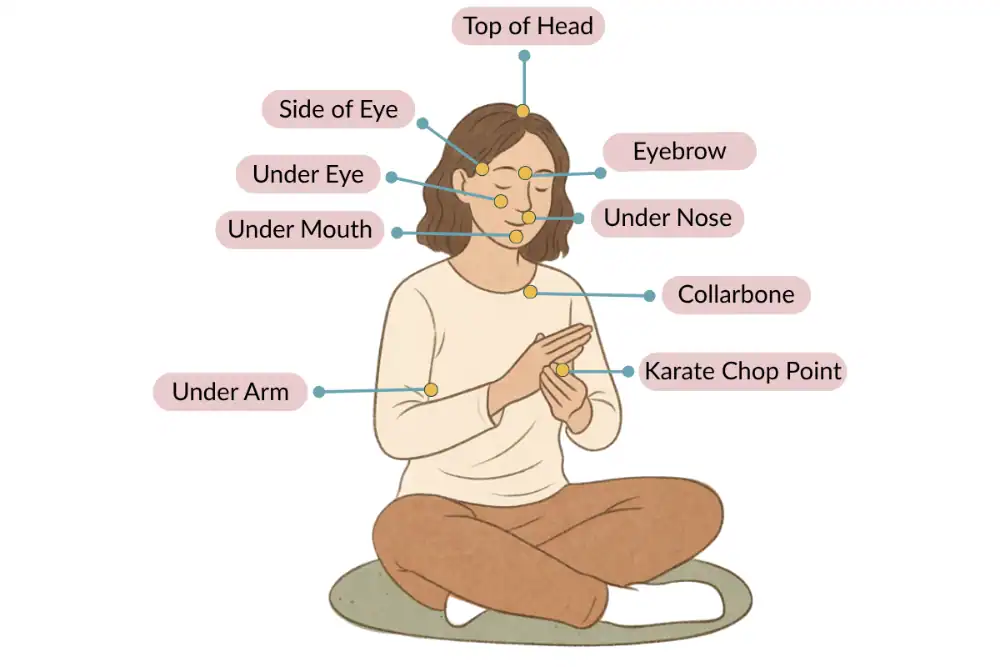
A 60-second EFT tapping round for clearer choices
Use two or three fingers. Tap gently on each point about five to seven times. Keep breathing normally. If a point feels awkward, skip it and keep going. If you lose your place, it does not matter. This is not a performance review.
The goal is not to force certainty. The goal is to create enough calm to take the next step.
Start with the choice that feels loud right now. Whether you are facing simple daily choices or navigating more complex high-stakes decisions, this sequence helps shift your perspective. It can be small, like what to tackle first, or bigger, like whether to say yes, no, or not yet.
- Tap the side of your hand and say, “Even though this choice feels like too much right now, I can give myself one minute.”
- Tap the eyebrow point and say, “Too many options.”
- Tap the side of the eye and say, “My mind is tired.”
- Tap under the eye and say, “I don’t need to solve all of this at once.”
- Tap under the nose and say, “I can soften this pressure.”
- Tap the chin point and say, “Maybe I only need the next step.”
- Tap the collarbone point and say, “I choose a little more space.”
- Tap the top of the head and say, “Clarity can come after I calm down.”
Pause. Breathe. Notice what shifted.
You are not looking for fireworks. You are looking for a little relief. Maybe the choice feels less charged. Maybe one option seems less terrible. Maybe your body stops bracing for a second. That counts.
If the stress is still high, do one more round with even plainer words. Try, “I am still overwhelmed, and I am here with myself.” Or, “I still do not know, and I do not have to punish myself about it.” Those are bridge thoughts. They do not pretend everything is fixed. They simply stop making the moment worse.
That matters more than people think. When your system softens, making decisions feels less like a burden and it becomes much easier to prioritize tasks. This is not about dramatic movie-scene action. This is about ordinary action. Close the extra tabs. Text a colleague that you will get back to them tomorrow. Pick the good-enough option. Rest before deciding. That is often what clarity looks like in real life.
When to use this quick reset, and what to expect
This form of decision fatigue tapping works best when used early, before a minor choice turns into a mental spiral. Use this practice before answering an overwhelming email, choosing between competing projects, making a purchase, or deciding if you have the capacity for one more task. It is particularly effective for curbing the impulsivity that often arises when choices feel heavy, and it acts as a circuit breaker for procrastination or decision avoidance. It is also an essential tool when your day begins to slide downhill and every simple selection starts to feel emotionally loaded.
There are limits to what this technique can accomplish, and that is perfectly okay. While these 60 seconds are excellent for managing your current mental energy, this exercise is not a substitute for restorative sleep or a cure for long-term burnout. If you are experiencing symptoms that feel chronic or unmanageable, please reach out to a mental health professional for support. If you find yourself in a state of full panic, start even smaller. Put your feet flat on the floor, drink a glass of water, or walk around the room. Only then should you begin to tap.
After the round, ask one gentle question: “What is the next kind thing I can do for myself?” Sometimes the answer is the decision itself. Sometimes the answer is a necessary pause. Sometimes it is simply saying “not now,” which, in itself, is a valid decision.
If no magical nudge arrives, that does not mean you failed. Often the real win is the moment you stopped fighting yourself. From there, the next clear move tends to reveal itself in a much less glamorous form. And remember: sometimes the most loving decision you can make is to decide that you don’t need to decide anything at all right now. Giving yourself permission to wait is not avoidance. It’s an act of self care. It may feel anticlimactic, but it is deeply useful.
Frequently Asked Questions
Do I need to be a professional at tapping to get results?
Not at all. The effectiveness of this technique comes from the physical act of interrupting your stress response rather than perfect execution. If you lose your place or tap on a slightly different spot, the process will still help ground your nervous system.
What if I feel silly while doing this?
It is completely normal to feel like tapping on your face is a strange way to handle a mental block. However, you do not need to believe in the method for it to lower your heart rate and provide some relief. Focus on the physical sensation of the taps and the grounding effect on your breathing.
Can I use this for major life decisions?
This 60-second reset is designed to lower the volume of internal static, not to provide a definitive answer for complex life paths. Use it to gain the mental clarity needed to approach big decisions calmly, rather than relying on it to magically reveal your next step.
Is this a replacement for therapy?
This exercise is a tool for managing temporary overwhelm and daily decision fatigue. It is not intended to treat chronic burnout, anxiety disorders, or long-term mental health challenges. Please consult with a professional if you feel that your decision-making struggles are persistent or overwhelming.
A gentler way to choose
When tiny choices start feeling weirdly enormous, you do not need a heroic mindset overhaul. You simply need less inner friction and a little more air. Developing an awareness of decision fatigue is the first step toward reclaiming your focus.
A fast tapping round can give you that relief. It is not about reaching perfect certainty or instant bliss, but rather finding enough space to stop wrestling with the moment and hear the next true thing. This practice helps you simplify routine choices and encourages the use of automated decisions for minor tasks, which is a powerful way to preserve your mental energy throughout the day.
Think of this quick reset as essential recovery time. By allowing for a moment of cognitive recovery, you prepare your brain to tackle the next task with renewed clarity. That is often all a tired mind needs. One minute. One breath. One choice that does not have to be spectacular to be right for now.
Two of my favorite online EFT practitioner websites are TapWithBrad.com and TheTappingSolution.com.

About Vickie Barnes
Twenty years in, by way of Wayne Dyer, Abraham Hicks, and EFT trained on Gary Craig's original methods.
I write from inside a family where several people I love are managing hard things, so I'm not going to hand you "raise your vibration" as a solution. It does work. Just slower and plainer than the books promise.