
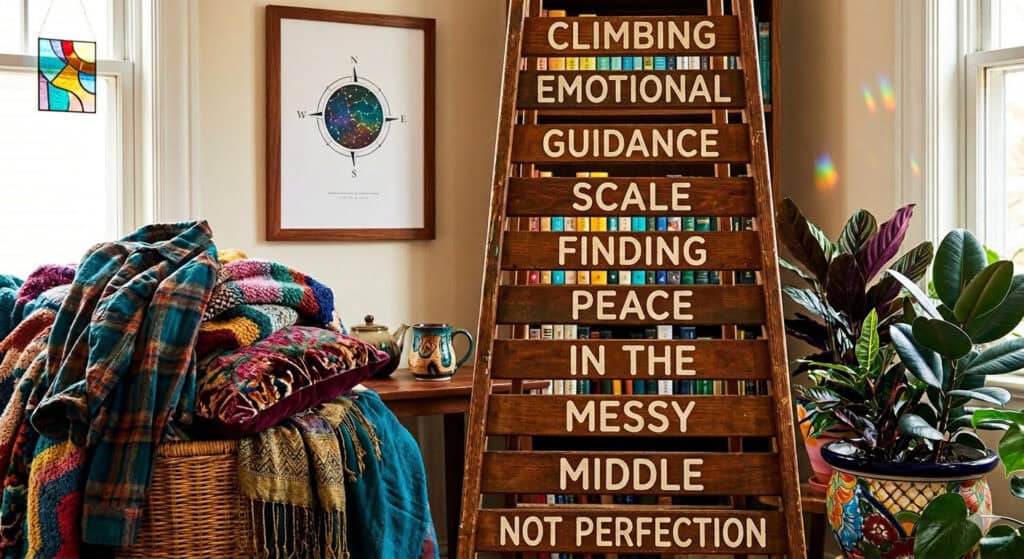
Some days, “self-care” sounds cute in theory, but in practice you’re hiding in the pantry for five minutes, staring at a mountain of laundry, and carrying 47 open tabs in the brain. You are not looking for a lecture on being high vibe. You want relief, a little oxygen, and maybe the ability to answer one text without feeling haunted.
That is where the Emotional Guidance Scale can help. Not because it asks you to fake joy, but because it gives you a gentler target. The goal is not to leap from despair to bliss like some spiritually sponsored circus act. The goal is to move one believable step and feel a little more like a person again.
Why the vibrational ladder helps when you are completely over it
When you’re fried, numb, or one minor inconvenience away from crying in the parking lot, pressure makes everything worse. Being told to “just be grateful” can feel like being handed a glitter sticker while your nervous system is on fire. Cute, but not useful.
The vibrational ladder offers a more honest way through. Instead of fighting your feelings, you work with where you actually are. If today feels like zombie mode, then that matters. You don’t need a gold star for pretending.
What helps is the next rung. Something believable. Something your mind and body won’t reject on sight. That is why this idea lands for so many people. It respects the messy middle.
The problem with trying to jump straight to gratitude
Going from depressed to joyful in one leap is vibrational nonsense. Your system knows when a thought feels fake, and it will usually respond with, “Absolutely not.”
So if you’re sitting on the floor, surrounded by unfolded clothes and mild despair, gratitude may not be the move. Relief is. A tiny bit of softening is. Even anger can be more useful than collapse, because at least anger has life in it.
Relief beats perfection. Every time.
What the Emotional Guidance Scale gets right about real emotional change
Real emotional change tends to happen in stages. You usually don’t wake up in hopelessness and skip merrily into peace by lunch. Most of us move in smaller shifts, and that is normal.
Naming your current state can also lower shame. If you can say, “I’m in frustration,” or “I’m in numbness,” then you stop acting like you’ve failed at healing. You’ve just located yourself on the map, and maps are handy when you’re lost.
A quick science side note, where this idea came from
The ladder idea gets linked to a few frameworks. One widely discussed source is David Hawkins and his map of consciousness, which suggests that emotions carry different energetic levels. Many people also know the Emotional Guidance Scale from Abraham-Hicks teachings.
This is not hard science you must swear loyalty to. It’s a framework, and for a lot of people, it helps because it turns a vague inner mess into something more workable. You don’t have to believe every claim to find the metaphor useful.
Why people still connect with the idea of emotional frequency
Simple answer, feelings have texture. Shame feels heavy. Hope feels lighter. Calm feels like your shoulders dropping half an inch without permission.
That body-based truth is why the ladder metaphor works. You can often feel the shift before you can explain it.
The ladder up, one rung at a time is still a huge win
If you’re in the messy middle, this is the part to keep. One rung matters. One notch of movement counts. You do not need a spiritual glow-up by Thursday.
Bottom rungs, despair, powerlessness, and the numb zombie zone
These states can look very ordinary. Doom scrolling for an hour. Staring at dishes like they personally betrayed you. Crying in secret, or feeling nothing at all, which is its own weird kind of exhaustion.

If that’s where you are, start tiny. Name it. Drink water. Stand outside for two minutes. Say, “This is where I am,” without adding a trial, a verdict, and a life sentence.
Why anger can be a promotion, not a failure
Here is the part people miss. Anger can be a vibrational promotion from despair or powerlessness. It can mean energy is coming back online. It can mean some part of you knows something is not okay.
That does not mean yelling at strangers or rage-texting your ex. It means seeing anger as movement. Anger can say, “Actually, no.” That is not peace yet, but it is often a step toward self-protection.
From frustration to hope, the middle rungs where life starts to come back
Frustration gets a bad reputation, but it beats flatlined helplessness. Frustration has motion. It says, “I hate this,” which is still more alive than “Nothing matters.”
From there, things can soften into maybe. Maybe this week won’t feel exactly like last week. Maybe I can do one thing. Maybe I can try again tomorrow with less drama and better snacks. That is how hope often enters, not with fireworks, but with a quiet little crack in the wall.
Higher rungs, relief, calm, and moments that feel like you again
Relief is the real milestone. Not perfection. Not constant peace. Just that first exhale.
Sometimes relief looks boring, and that is excellent news. You take a shower. You answer one email. You fold two shirts from the laundry mountain. You notice the sky on the way to the car. Calm and appreciation may come later. For now, relief is already success.
Quick pivot for a busy brain, try the ABC Game
When your mind starts spinning like a browser with 47 open tabs, you need a simple interrupt. The ABC Game is great for that because it gives your brain one harmless job.
How the ABC Game works when your brain has 47 open tabs

Pick a theme, then move through the alphabet. You can choose foods, songs, cities, comfort objects, or movies you’ve watched too many times. A for apple, B for bagel, C for coffee, and keep going until your brain unclenches a little.
You don’t have to reach Z. The point is gentle redirection, not performance. It’s a soft hand on the mental steering wheel.
When to use it, and why it helps more than forcing a better mood
Use it in the car line, in a waiting room, at bedtime, or during a five-minute pantry retreat. It helps because it shifts attention without demanding a fake emotional makeover.
That small redirect can create space. Not magical healing, just enough room to move from overwhelm to manageable. And honestly, manageable is sometimes holy.
The vibrational ladder is not about pretending everything is fine. It is about getting more breathing room inside a hard moment. If anger shows up, that can be progress. If relief shows up, that is a win. One small shift still counts, and sometimes that is exactly how you come back to yourself.