
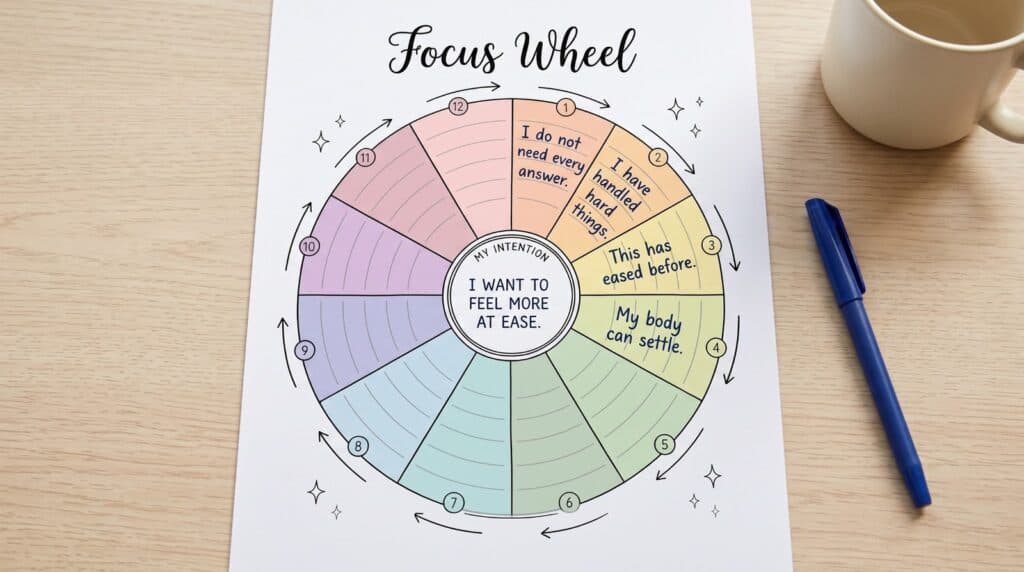
A focus wheel is one of the simplest things Abraham Hicks ever handed out, and one of the easiest to overthink. You write a statement in the middle of a circle. Then you build a ring of slightly better-feeling thoughts around it. That’s the whole tool.
What makes it work is that it never asks you to leap. Affirmations ask you to leap. A focus wheel asks for one thought your mind can actually live with, then another one after that, and your nervous system gets to come along instead of being dragged.
It works for money, for a relationship that’s gone quiet, for a decision you keep circling. It’s especially good for anxiety, and that’s where most of the examples below live. Anxious thoughts build speed. This is a way of interrupting them without asking you to pretend you feel wonderful.
Key Takeaways
- Focus on Believability, Not Perfection: The goal of a focus wheel is not to reach immediate bliss, but to shift from a harsh thought to a slightly softer, more believable one to reduce internal friction.
- Interrupt the Feedback Loop: Anxious thoughts build momentum. The wheel works as a circuit breaker, so your nervous system can stop bracing for disaster.
- Prioritize Gentle Grounding: If you find yourself stuck, do not force the process. Use physical grounding techniques like the 3-3-3 rule or simple movement to reset your mental momentum.
- Support, Not Replacement: It is a good tool for everyday stress. It is not a substitute for therapy or medical care.
What a focus wheel is, and why it works
The Abraham Hicks Focus Wheel is a simple thought tool. You place one statement in the center, then build a circle of slightly better-feeling thoughts around it. There are no rigid rules here. Traditional focus wheels usually have 12 spokes to help build positive momentum, but let’s be real, this isn’t a homework assignment or an art project. If your mind is racing and you manage to find three or four honest, believable thoughts that make your shoulders drop, you’ve won. Stop there and enjoy the relief.
What makes it helpful for anxiety is the way it works with momentum instead of fighting it. Anxious thoughts build fast. One weird text becomes a whole documentary. One bill becomes “my life is ruined.” One awkward moment becomes “I should move to a cabin and never speak again.”
Trying to jump straight from that state into “Everything is perfect and I am pure light” usually does not help. Your body knows when a thought feels fake. You start out worried. Then you get annoyed that your calming practice is not calming you. Not ideal.
A focus wheel gives you a middle path. It helps you move from a harsh thought to a softer one, then to another, and maybe another. You are not forcing happiness. You are reducing internal friction.
That matters because anxiety often feels like pressing the gas pedal and the brake at the same time. You want relief, but part of your mind is yelling, “No, stay alert, something bad could happen.” The strain is exhausting.
The goal isn’t to feel amazing. The goal is to feel a little less braced.
If you enjoy Abraham Hicks language, you can call that alignment. If you prefer plain English, call it giving your nervous system a break. Same idea, less glitter.
A gentle note, because it matters. This is a thought tool, not medical care. If anxiety is intense, or constant, or getting into your sleep and your days, please talk to someone who can actually help. Asking for that is a good move, not a failure of alignment.
Get the free focus wheel template (PDF)
I made you a blank one. Twelve numbered spokes, a circle in the middle for your intention, and faint lines inside each spoke so your handwriting has somewhere to go.
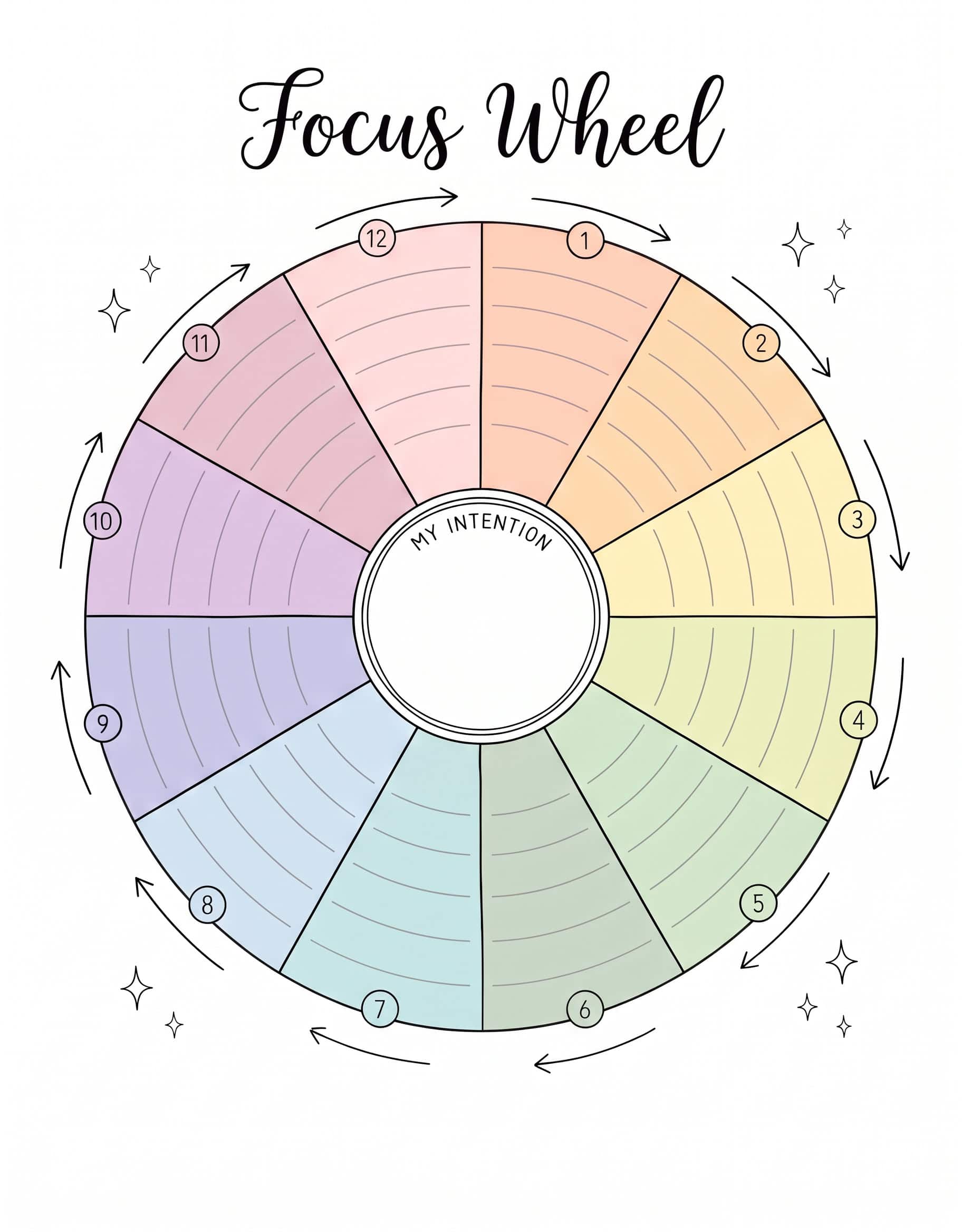
I made you a blank one. Twelve numbered spokes, a circle in the middle for your intention, and faint lines inside each spoke so your handwriting has somewhere to go.
Two versions in the same file. Color, because it’s nicer to look at. Black and white, because printing color at home is its own small act of courage, and because some people would rather color it in themselves.
Print a few while you’re at it. The wheel works better as something you scribble on than something you keep tidy, and you’ll want another one next week.
Two versions in the same file. Color, because it’s nicer to look at. Black and white, because printing color at home is its own small act of courage, and because some people would rather color it in themselves.
Print a few while you’re at it. The wheel works better as something you scribble on than something you keep tidy, and you’ll want another one next week.
How to do a focus wheel without picking a fight with yourself
Start on paper if you can. A notebook works better than trying to do this while half-reading your notifications. Your phone has many talents, but helping an activated brain settle is not always one of them.
The process is simple:
- Write down the anxious topic. Keep it specific enough to name, but don’t spiral into the whole saga.
- Choose a center statement that feels a bit better, not wildly better.
- Add short thoughts around it, each one believable enough that your body doesn’t tense up.
- Stop when you feel some relief, even if it is small.
For anxiety, the center statement often works best when it is general. Purists might note that the center is traditionally reserved for your ultimate target desire. But when you are in a high-anxiety spiral, writing a big, bold desire in the center can feel like a target you’re failing to hit. By using Abraham’s concept of ‘going general’ right in the center statement (e.g., ‘I want to feel a little more at ease about this’), you take the pressure off before you even begin the spokes.
From there, keep reaching for thoughts your mind can live with. Not perfect thoughts. Not shiny thoughts. Thoughts with a little more space in them.
You might write, “I don’t know everything yet.” Then, “I’ve handled uncertainty before.” Then, “I only need the next step.” Then, “My body can calm down a little, even before I have every answer.”
That is the wheel doing its job.
If you get stuck, do not force another spoke just to finish the exercise neatly. Sometimes the best next move is physical movement. You can try drinking water, stepping outside, or focusing externally by identifying three sounds or three objects in the room. You might also try the 3-3-3 rule, where you name three things you see, three sounds you hear, and move three parts of your body. Put your hand on your chest, take a shower, or watch a familiar show. Sleep is often underrated here. It resets thought momentum better than most mindset work, and tomorrow morning usually gives you a cleaner starting point.
Abraham Hicks focus wheel examples
The trick with these examples is not copying them word for word. The trick is noticing the tone. Each thought softens the last one. None of them try to strong-arm your mind into bliss.
Social anxiety before seeing people
If you are nervous before a party, meeting, or family thing, your center thought might be, “I would like to feel more comfortable around people tonight.”
From there, you could try thoughts like, “I do not need to impress everyone.” “It is enough to connect with one person.” “Some people there are probably nervous too.” “I can take a break if I need one.” “I have made it through awkward moments before.” “I am allowed to be quiet without making it a personality crisis.”
If you want fill-in help, try lines like, “I only need to feel ___ percent more relaxed,” or, “It is okay if I feel nervous and still ___.”
The objective stays the same either way. Social anxiety often eases when you stop demanding a perfect performance. Your job is not to become magnetic by 7 p.m. Your job is to feel a little safer in your own skin.
Overthinking after a conversation
This one is for the 11:42 p.m. replay loop, where your brain reopens a conversation like it is reviewing security footage.
A solid center thought is, “I want to stop making this bigger than it is.”
Then build from there. “I may not have the full story.” “People have their own moods.” “One weird pause does not mean disaster.” “I do not need to do an autopsy on every sentence.” “If something needs attention later, I can handle it later.” “Right now, I can let this settle.”
For a fill-in version, try, “Even if I said ___, it does not automatically mean ___,” or, “I can give this conversation more room before I decide it was ___.”
This kind of anxiety loves certainty, and usually in the least helpful direction. A focus wheel interrupts that habit. It gives you room to stop treating one human moment like courtroom evidence.
Uncertainty about work, money, or the future
Uncertainty is rough because it makes your mind demand answers it cannot produce on command. You might find yourself running worst-case scenarios on a loop. When your brain demands certainty it cannot have, everyone gets cranky, including you.
A center thought here could be, “I want to feel steadier about what I do not know yet.”
Possible spokes might sound like this: “Not knowing everything is uncomfortable, but normal.” “I do not need to solve the whole month this afternoon.” “There may be options I cannot see while I am tense.” “A calmer mind notices better choices.” “I can take one practical step today.” “Progress can start small.”
If you need blanks, try, “The next helpful step might be ___,” or, “I can handle ___ without predicting the entire future.”
This is where Abraham Hicks can feel more grounded than people expect. Your inner state does affect what you notice, how you speak, and whether you act from clarity or panic. It is not a crystal ball. It is a compass.
Nighttime worry when your brain won’t clock out
Night worry has a special flair for drama. Everything feels louder after dark. Bills feel bigger. Relationships feel doomed. Your future suddenly looks like a bleak indie film.
A good center statement is, “My job tonight is rest, not solving everything.”
Instead of letting these worries consume your sleep, try designating a specific worry time earlier in the day to solve problems, allowing yourself to release them at night. Then try thoughts like, “I do not have to figure this out before sleep.” “Morning usually feels different.” “My brain is less reliable when I am tired.” “Rest is productive for me right now.” “I can let this be unfinished for a few hours.” “I am safe enough in this moment to soften.”
Fill-in versions can help here too: “This thought can wait until ___,” or, “Tonight I am allowed to put down ___.”
Nighttime anxiety often needs less brilliance and more interruption. Lower the lights. Put the phone down. Let the wheel end with relief, not perfection.
Fill-in-the-blank focus wheel prompts
When your mind is noisy, staring at a blank page can feel overwhelming.
Here are a few starting points for when it spikes:
- “I want to feel a little more ____ about this.”
- “I don’t need the full answer, I only need ____.”
- “Even if I feel anxious, I can still ____.”
- “It is possible that this is not as ____ as it feels right now.”
- “I can let myself pause before I ____.”
- “There may be more support available than I can see when I am ____.”
- “I have handled ____ before, even if not perfectly.”
- “For tonight, it is enough to ____.”
- “I can stop replaying ____ for the next few minutes.”
- “The next kind thing I can do for myself is ____.”
If one of those prompts feels too big, try making it more general. General thoughts often work better when anxiety is high because they are easier for your brain to accept. “Things can shift” is often more believable than “Everything is wonderful.” In this process, finding a thought that feels believable always wins.
If no sentence helps in the moment, that does not mean you have failed. It may simply mean your system needs rest first. Remember that a focus wheel is meant to be a form of support, not a piece of homework.
Frequently Asked Questions
Do I need to be a fan of Abraham Hicks to use this tool?
Not at all. While the tool originates from those teachings, it functions simply as a practical cognitive exercise for reducing internal friction and softening anxious thought patterns without requiring you to adopt any specific spiritual beliefs.
Can I use a digital app for my focus wheel?
While you can technically use a screen, writing on paper is highly recommended for anxiety. Digital devices often carry notifications and stressors, whereas pen and paper allow you to disconnect and focus on grounding your nervous system without external interference.
How many spokes should my wheel have?
There is no rigid requirement for the number of spokes. Traditionally there are 12 spokes, but honestly? If you get three or four honest thoughts that make your shoulders drop, you’ve won. Don’t turn a healing tool into a homework assignment.
What if I can’t find any ‘better-feeling’ thoughts?
Drop the pen and walk away. Forcing yourself to think positively when you’re completely wrung out will only create more friction. If you’re stuck, your system probably just needs a physical reset. Go drink a glass of water, step outside for some fresh air, or go to sleep. Sleep is an incredibly underrated circuit-breaker for negative thought momentum, and tomorrow morning will give you a much cleaner starting point.
A softer thought is enough
Anxiety usually gets louder when you try to wrestle it into silence. A focus wheel offers a different move: you soften the next thought, then the next one, until your mind stops bracing so hard.
That is why this practice can be so comforting. It does not ask you to become fearless. It asks for one believable thought that gives you a little more room to breathe. Sometimes that thought is simple, such as, “I do not have to solve my whole life before bed.” Often, that is plenty. And if it is not enough on its own, ask someone else for help. Nobody hands out alignment points for white-knuckling it.
✨✨ Interested in learning more about the teachings of Abraham? Hop on over to the Abraham Hicks website. ✨✨

About Vickie Barnes
Twenty years in, by way of Wayne Dyer, Abraham Hicks, and EFT trained on Gary Craig's original methods.
I write from inside a family where several people I love are managing hard things, so I'm not going to hand you "raise your vibration" as a solution. It does work. Just slower and plainer than the books promise.