
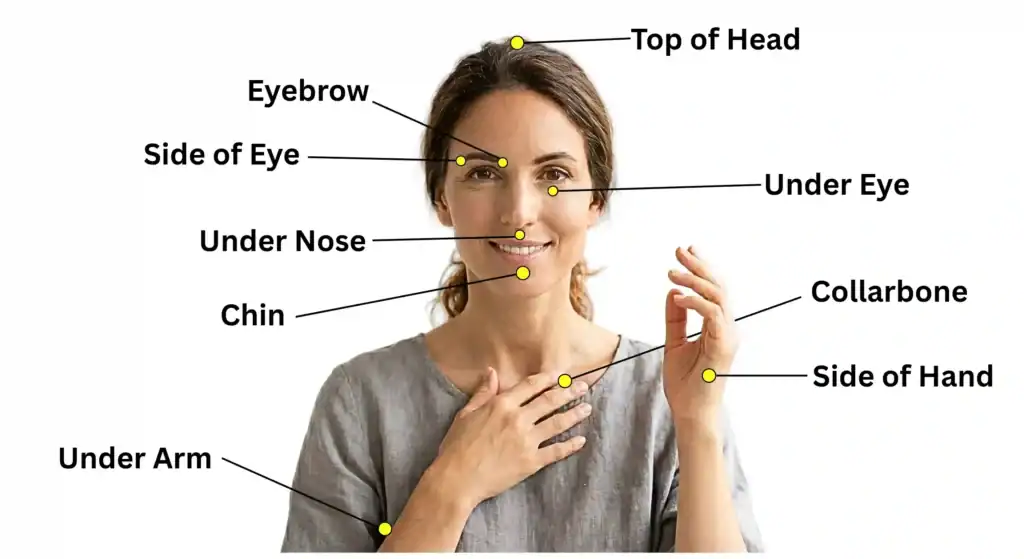
When your thoughts are racing, a long wellness routine can feel like one more thing you are about to do wrong. EFT tapping is smaller than that. You tap a few points on your body while naming what feels hard, then see if your system can soften by even one notch. This simple approach is formally known as the Emotional Freedom Technique.
The EFT tapping points follow a familiar order, but you do not need perfect aim or a spiritual personality transplant to use them. A gentle round at your kitchen table still counts, and many people use this effective mind-body practice to manage their daily stress and anxiety.
Here is where each point is, what comes next, and how to try the sequence without turning it into a performance review.
Key Takeaways
- The usual beginner sequence includes the side-of-hand point, followed by the eight traditional EFT tapping points on the face and upper body.
- You can tap using two or three fingertips on either side of the body.
- Most people tap each point about five to seven times, though there is no magic number.
- Start by naming what is true, even if the truth is that you feel tense and do not know why.
- EFT is a self-help practice, not a replacement for medical or mental health care.
What EFT Tapping Is, Without the Complicated Bit
EFT stands for Emotional Freedom Technique. Rooted in the principles of Traditional Chinese Medicine, the practice combines gentle stimulation of specific points with acupressure techniques and words that keep your attention on a feeling, worry, memory, or stressful situation.
When you tap, you send calming signals to the brain that help lower cortisol levels and deactivate the body’s fight-or-flight response. You do not have to be an expert in energy meridians to benefit from this; the most useful question is simply whether a minute of tapping helps you feel less braced.
A beginner’s overview from The Tapping Solution describes the standard tapping sequence as moving through nine points in order. You may see small differences across charts, especially around the top of the head point or older routines. That is normal. The version below is the common sequence used in modern beginner practices.

Before you begin, give the feeling an intensity scale rating on a 0 to 10 scale. A rating of 0 means the issue barely bothers you, while 10 means it feels overwhelming. This is not a test. It simply provides a way to notice if you feel different after a round.
You are not trying to erase a feeling on command. You are giving yourself a calmer place to stand beside it.
The Traditional Order of the Nine EFT Tapping Points
Use the pads of two or three fingers and tap lightly. You are not knocking on a door. Gentle, steady contact is enough. These tapping locations correspond to specific acupoints along the energy meridians that are central to the practice.
You can tap on one side of the body or both sides. The points on the face are easy to reach with one hand. Switch hands if that feels more comfortable. The order matters more than exact precision, and even then, no one is handing out grades.
1. Karate Chop point (the setup point)
Hold one hand open, palm facing you. Tap the fleshy outer edge of the other hand, below the little finger. It is the spot you would use for a karate chop motion, though nobody needs to chop anything today.
This point is often used while saying a setup phrase three times. The goal is to combine a setup statement with a sense of self-acceptance. Try:
“Even though I feel stressed about this conversation, I am open to giving myself a little kindness.”
Use words you can believe. If “I completely love and accept myself” feels like a bridge too far today, do not force it. “I can be here with myself for one minute” works beautifully as a setup phrase.
2. Eyebrow point
Tap at the inner edge of either eyebrow, close to the bridge of your nose. Do not tap directly on your eye. Stay on the bony area where the brow begins.
Name the issue in a short phrase: “This tight feeling.” You are not making it bigger. You are letting your mind stop pretending it is not there.
3. Side of Eye
Move to the bone at the outside corner of either eye. Again, tap beside the eye, not on the soft eye area itself.
You might say, “I have been carrying a lot.” Keep your wording plain. EFT does not need a polished speech. It works better when you sound like yourself.
4. Under Eye
Tap on the bone about an inch below either eye, roughly in line with your pupil when you look straight ahead. Avoid pressing into the eye socket.
This point can feel surprisingly grounding because you are already moving slower. Try, “I do not have to solve it all right now.”
5. Under Nose
Tap in the small area between the bottom of your nose and your upper lip. Use a light touch, especially if this spot feels tender.
A useful reminder phrase might be, “This is still here.” That may not sound uplifting, but honesty often settles the nervous system faster than trying to jump straight into sunshine.
6. Under Mouth (Chin point)
The Under Mouth point is in the crease between your lower lip and the rounded part of your chin. It is not the tip of your chin. Think of the little indentation just below your mouth.
Say whatever feels true: “I am tired of thinking about this.” Sometimes that is the first honest thing you have said to yourself all day.
7. Collarbone point
Find the U-shaped notch at the base of your throat. From there, move down about an inch and out an inch or two toward either side. You can tap with a flat hand over the upper chest if locating the exact spot feels fussy.
This is a good point for a softer reframe: “Maybe I can take the next small step.” Not the whole staircase. Not your five-year plan. Just the next step.
8. Under Arm
Lift one arm slightly and tap on the side of your ribs, about four inches below the armpit. For many people, this is around bra-strap level. Tap either side.
If you are in public, you can skip this point or tap it discreetly with your arm down. The world will continue turning. Your tapping round has not been ruined.
9. Top of Head
Finish at the crown of your head. This is the soft, central area at the very top, rather than your forehead or the back of your head. Tap gently with several fingertips.
End with a phrase that offers a little room: “I can let this soften.” Or, if that feels too ambitious, “I am willing to breathe here.”
The setup point is included in the nine-point count in many beginner guides. After the setup, you move through points two through nine in the order above.
How to Do One Gentle EFT Tapping Round
You do not need candles, special music, or a private mountaintop. You need about two minutes and a specific challenge that feels present enough to name. The Emotional Freedom Technique works best when you focus on one narrow issue at a time. While you might feel overwhelmed, try to hone in on a specific trigger, such as the email you have not opened or the physical tightness in your stomach before a meeting. This focus helps you better manage feelings of stress and anxiety.
Start at the side of your hand. Repeat your setup statement three times to prepare your mind. Then, move through the remaining tapping sequence points once, using a short reminder phrase at each spot.
Here is what that can sound like:
- Setup Statement: “Even though I am dreading that email, I can give myself some grace.”
- Eyebrow: “Dreading this email.”
- Side of Eye: “I don’t want bad news.”
- Under Eye: “My body is already tense.”
- Under Nose: “I keep putting it off.”
- Chin: “Part of me wants to hide.”
- Collarbone point: “I can handle one small piece.”
- Under Arm: “Maybe it is not as impossible as it feels.”
- Top of head: “I can open it when I am ready.”
Pause. Breathe normally. Check your intensity scale again. Using a 0 to 10 scale helps you gauge your current emotional state.
The number may drop. It may stay the same. You may notice the feeling has changed shape, which is its own useful bit of information. If the intensity remains high, repeat another round with whatever is now most true.
For a second round, you might shift from “I am dreading this” to “I am still nervous, but I can read the first line.” That is not toxic positivity. It is simply a smaller thought your body may be able to accept as you continue your tapping sequence.
What to Do When Tapping Feels Awkward
At first, tapping on your face while talking to yourself can feel a little odd. Fair enough. Many helpful things look strange from the outside, including foam rollers and people talking into Bluetooth earbuds at the grocery store.
You do not have to believe a grand theory for the Emotional Freedom Technique to be useful for stress and anxiety. Think of it as a form of acupressure that works with your body’s energy meridians, even if you are skeptical about the underlying mechanism. Approach it as an experiment. Notice your shoulders before and after a round. See whether you breathe more freely. Pay attention to whether you can make one clearer choice.
You can also tap silently. Use a simple phrase in your mind, such as “This pressure” or “I need a minute.” If words make things feel too loud, focus on the physical sensation in your body and keep tapping.
For broader support around physical stress patterns, these body-based ways to release stored stress offer gentle ideas that can sit alongside a tapping practice.
If tapping brings up intense memories, panic, numbness, or emotions that feel too big to hold alone, stop. Put both feet on the floor. Look around the room and name a few ordinary things you can see. A licensed mental health professional can offer support that a self-guided technique cannot replace.
A Few Common Questions About the Sequence
Do I have to tap both sides?
No. One side is fine. Some people prefer both sides because it feels balanced, but it is not required.
What if I miss a point?
Keep going. You have not broken the tapping sequence. Return to the point if you want, or begin another round.
How hard should I tap?
Use your fingertips to tap lightly enough that it does not hurt. Think of drumming your fingers on a tabletop while waiting for the kettle to boil.
How many rounds should I do?
One to three rounds is a reasonable place to start. For each new issue, begin your session at the Karate Chop point. Stop when you feel calmer, distracted, tired, or done. You do not need to tap until you become a different person.
Let the Sequence Be Simple
The nine EFT tapping points are not a rigid map you must memorize perfectly before you are allowed to feel better. They follow a repeatable order: side of hand, eyebrow, side of eye, under eye, under nose, chin, collarbone, under arm, and finally the top of head.
On a hard day, gentle and imperfect is still a real practice. You can use these EFT tapping points as a reliable tool for managing stress and anxiety whenever you need support. Whether you are focusing on the eyebrow point to begin or completing the sequence at the top of head, remember that the goal is simply to show up for yourself. Tap through one round, tell the truth about what hurts, and let relief be small if small is what is available. This gentle mind-body practice is ultimately a path toward deeper self-acceptance, so allow the process to remain simple and kind.
Two of my favorite online EFT practitioner websites are TapWithBrad.com and TheTappingSolution.com.

About Vickie Barnes
Twenty years in, by way of Wayne Dyer, Abraham Hicks, and EFT trained on Gary Craig's original methods.
I write from inside a family where several people I love are managing hard things, so I'm not going to hand you "raise your vibration" as a solution. It does work. Just slower and plainer than the books promise.