

Some nights, your body is tired but your mind has decided to host a full staff meeting at 1 a.m. You replay conversations, predict disasters, remember something embarrassing from 2014, and find yourself struggling with racing thoughts about an email you have not even opened.
EFT sleep tapping is a small practice that may help you soften that bedtime stress. This method, formally known as the Emotional Freedom Technique, involves light stimulation of acupressure points to signal safety to your nervous system. It will not force sleep to show up on command, because sleep is stubborn like that, but it can give your mind and body a gentler place to land.
Key Takeaways
- EFT tapping pairs light fingertip tapping with honest, calming words to help settle the mind.
- A bedtime round works best when you focus on one manageable worry instead of your entire life story.
- The goal is emotional relief rather than forcing instant or perfect results, though it can help you transition into restful sleep.
- Current evidence for EFT is more encouraging for managing stress and anxiety than it is for treating insomnia.
- Ongoing sleep problems deserve support and guidance from a qualified healthcare professional.
Why Tapping Can Feel Calming Before Sleep
EFT stands for Emotional Freedom Technique, a mind-body technique that many people simply call tapping. When you practice this method, you tap lightly on a specific sequence of acupressure points on the face and upper body while focusing on a thought, feeling, or physical sensation. By stimulating these meridian points, you send a signal to your nervous system to transition into a relaxation response.
It can feel a little strange at first. You are sitting in bed, tapping near your eyebrow, talking to yourself in a low voice. But plenty of helpful things look odd from the outside, including foam rolling and wearing a sleep mask that makes you resemble a tiny glamorous burglar.
The useful part is not getting every point perfect. EFT tapping gives your hands a rhythm, your attention a job, and your feelings somewhere to go besides around and around your head.

Bedtime is often when daytime stress finally catches up with you. There is less noise. Fewer tasks are demanding your attention. Then the thoughts you pushed aside while answering messages and finding clean socks begin lining up at the door.
A tapping round can interrupt that momentum. You are not trying to convince yourself that everything is fine. You are naming what is here, then offering your body a little room to breathe.
While the research is evolving, there is increasingly evidence-based data supporting the use of these techniques for emotional regulation. Some people report that it helps them feel calmer, especially when anxiety is loud. Cleveland Clinic’s overview of EFT tapping offers a balanced look at the practice, its common uses, and its limits.
You do not need to feel peaceful before you start tapping. Starting while you feel tired, irritated, or worried is kind of the point.
A Simple EFT Sleep Tapping Routine
Save this EFT sleep tapping routine for the moment you have turned off the light, checked the clock too many times, and started mentally negotiating with sleep. You can sit up in bed, lie down, or do the round in a chair before heading to the bedroom.
Pick one specific issue. “I have too much to do tomorrow” works better than “everything is terrible.” “I keep thinking about that conversation” is also plenty.
Before you begin, notice how tense the feeling seems on a scale from 0 to 10. This is not homework. You are only checking in with yourself to encourage deep relaxation. A number might not come easily, and that is okay.
Use two or three fingertips and tap each of the tapping points about five to seven times. Tap gently. You do not need to hit a secret button hidden under your eyebrow.
Start at the side of your hand
Tap the fleshy outer edge of either hand, below your little finger. Say this three times, slowly:
“Even though my mind is still awake, I can let this moment be a little easier.”
If that feels too polished, use words you would say on a hard night:
“Even though I am tired and wound up, I do not have to solve everything right now.”
Honest words tend to work better than shiny ones your body does not believe.
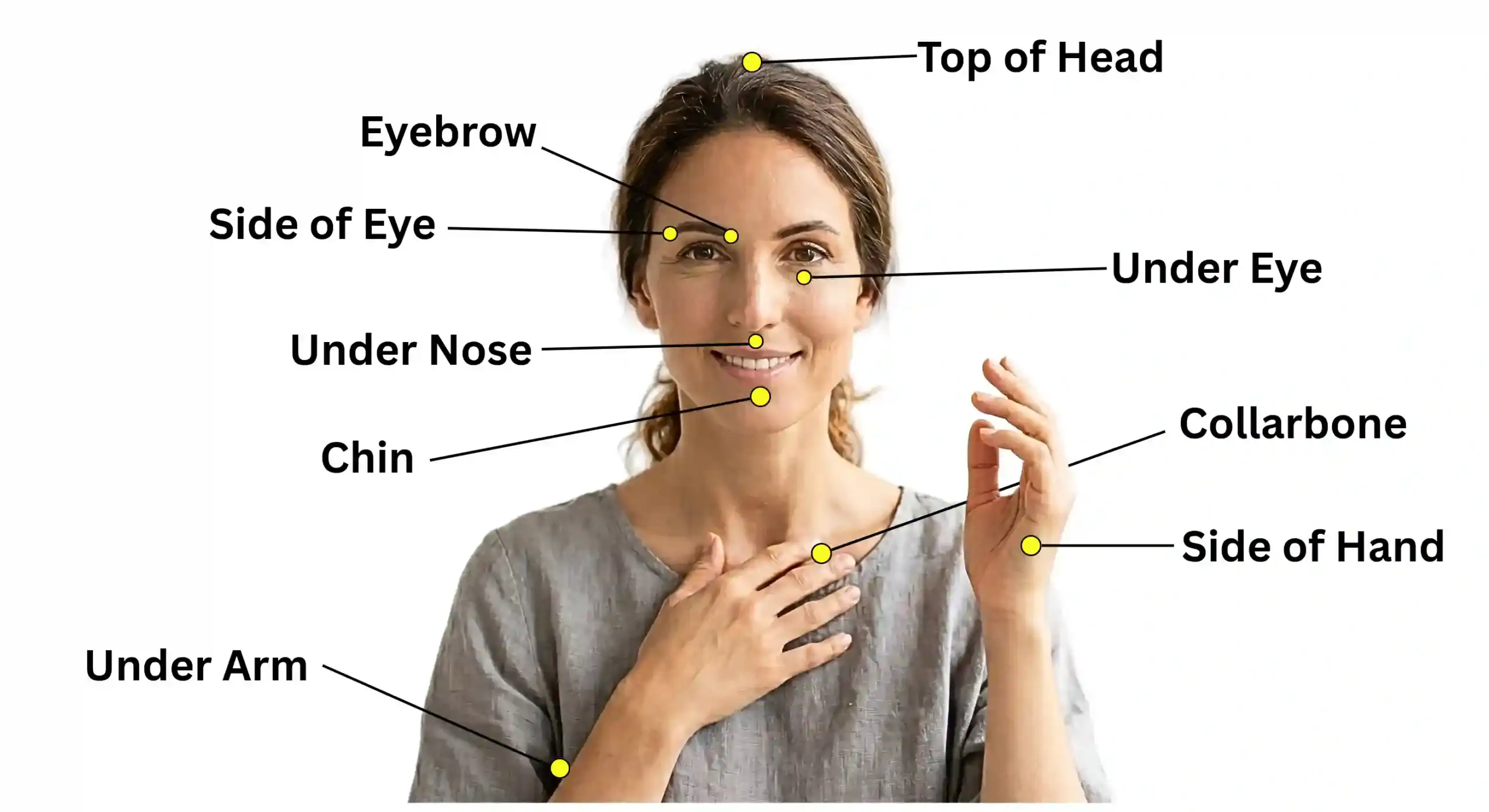
Tap through the usual points
Move through this tapping sequence in order. You can use a consistent tapping script, repeating a short phrase at each point, or change the words as you go.
- Eyebrow: “My mind is still going.”
- Side of the eye: “There is a lot sitting on me.”
- Under the eye: “I am tired of thinking.”
- Under the nose: “Part of me wants to stay alert.”
- Chin: “Maybe I can put some of this down.”
- Collarbone: “I do not need all the answers tonight.”
- Under the arm: “My body can soften a little.”
- Top of the head: “I can rest, even before I sleep.”
Take one slow breath. Notice the bed beneath you. Feel the weight of the blanket, the temperature of the room, and the fact that you have made it through every difficult night before this one.
Then check your number again. Maybe it dropped from an eight to a six. Maybe nothing changed, except you stopped fighting yourself for one minute. That still counts.
You can repeat the round once or twice. If you start yawning halfway through, congratulations, your body may be taking the hint. Let yourself stop. You do not need to finish the sequence for it to be valid.
For a follow-along option, this guided sleep tapping video can be useful when you are too tired to remember which point comes next.
When Your Brain Refuses to Cooperate
Sometimes a soft bedtime phrase can feel almost insulting. If you are panicking about money, grief, pain, work, or a relationship, saying “I am completely calm” may make your whole system say, “No, we are not.”
Do not force it.
Try a bridge thought instead. A bridge thought is not wildly positive. It is a sentence that feels one notch more bearable than the thought you have now. Using EFT tapping during these moments can help you regain a sense of emotional balance, especially when your internal state feels heavy or resistant. These phrases are designed to soothe your nervous system when it is stuck in a high-alert state, helping you transition away from reactive patterns.
You might tap through the points using phrases like:
- “I do not know how to fix this tonight.”
- “This is hard, and I am here with myself.”
- “I can deal with tomorrow when it is tomorrow.”
- “For the next few minutes, I am safe in this bed.”
- “Maybe my body can rest a little before my mind catches up.”
That last one is often enough. Your mind might keep talking. Fine. It has opinions. You do not have to argue with every single one.
If tapping makes you feel more activated, pause. Put both feet on the floor if you can. Look around and name five ordinary things you see. Take a sip of water. Choose a smaller issue, or skip tapping for the night.
Make the Practice Part of a Softer Wind-Down
Tapping works well as a transition between the day you had and the rest you want. It is easier to settle when you do not go directly from scrolling alarming news on a screen to expecting instant peace. By viewing this practice as part of your overall sleep hygiene, you can create a gentle buffer that prepares your body for the night ahead.
Try a short routine that feels realistic for your life. Wash your face. Dim the lights. Put your phone across the room, or at least face down. Do one round of tapping for the thought that is loudest. Then let yourself lie there without making the process of falling asleep feel like a performance review.
You can also use EFT tapping earlier in the evening to manage your stress and anxiety. Try it after a tense call, after checking your bank balance, or while sitting in the car before you walk into the house. Releasing a little pressure at 7 p.m. can be kinder than waiting until 2 a.m. when your thoughts have become a small, poorly managed parade. Prioritizing these moments is a simple way to improve your sleep quality and ensure you get a more restful sleep each night.
Keep your bedtime wording simple. You do not need an elaborate script, special music, or a perfect candle situation. The practice is about returning to yourself in a small way.
EFT Tapping Is Not a Treatment for Every Sleep Problem
Stress can absolutely make sleep harder. A calming ritual may help you feel less braced, and that is meaningful. Still, EFT sleep tapping is a supplemental tool rather than a cure for chronic insomnia, sleep apnea, chronic pain, depression, trauma, or other conditions that affect rest.
Talk with a doctor, therapist, or qualified sleep professional if sleep troubles last for weeks, interfere with daily life, or leave you exhausted most days. Seek prompt medical advice for loud snoring with gasping, breathing pauses during sleep, severe daytime sleepiness, or sleep problems tied to medication changes.
Tapping can sit alongside practical support. While research into clinical EFT continues to grow, a clinician may suggest evidence-based treatments such as cognitive behavioral therapy for insomnia, a sleep study, changes to medication, or another approach based on what is going on. You deserve more than being told to drink chamomile tea and hope for the best.
Frequently Asked Questions
Do I need to memorize the tapping points to see results?
No, you do not need to be perfect with the sequence for it to be effective. The primary goal is to give your mind a focus and your body a rhythmic, soothing input, so tapping near the correct general area is sufficient.No, you do not need to be perfect with the sequence for it to be effective. The primary goal is to give your mind a focus and your body a rhythmic, soothing input, so tapping near the correct general area is sufficient.
Can I use EFT tapping if I am feeling really anxious or panicked?
Yes, but focus on ‘bridge thoughts’ that feel honest and bearable rather than trying to force yourself to feel calm. If you find the tapping makes you feel more activated, it is perfectly okay to stop, focus on your breathing, or simply lie still until you feel more grounded.
How long should I practice tapping before bed?
There is no set time limit, but a single round or two usually takes just a few minutes. If you find yourself yawning or drifting off mid-sequence, you have permission to stop whenever you like; the goal is relaxation, not completing a rigid checklist.
Is EFT tapping a substitute for professional medical help?
No, EFT tapping is a supplemental tool for emotional regulation and is not a substitute for professional medical treatment for clinical conditions like chronic insomnia or sleep apnea.lt a qualified healthcare professional for support.
It is a wonderful, gentle way to help settle your nervous system on a hard night, but if you are constantly exhausted and fighting for rest, you deserve comprehensive support from a qualified doctor.
Let Bedtime Be a Little Less of a Battle
A tapping practice cannot make life stop being life. The inbox will still be there, and tomorrow may still need your attention. However, you do not have to carry every unfinished task into bed as if it were a required overnight guest.
Use EFT sleep tapping as a small signal of safety and self-kindness. Tap gently, tell the truth, and look for one inch of relief instead of a dramatic breakthrough. By incorporating this practice as a gentle transition into the night, you can calm your nervous system and gradually improve your overall sleep quality. Sometimes that single inch of relief is exactly where sleep begins.
Two of my favorite online EFT practitioner websites are TapWithBrad.com and TheTappingSolution.com.

About Vickie Barnes
Twenty years in, by way of Wayne Dyer, Abraham Hicks, and EFT trained on Gary Craig's original methods.
I write from inside a family where several people I love are managing hard things, so I'm not going to hand you "raise your vibration" as a solution. It does work. Just slower and plainer than the books promise.