

At a Glance: What is EFT Tapping?
EFT (Emotional Freedom Technique) is a simple self-help method that combines a calming physical rhythm with honest self-expression to help lower stress and shift difficult emotions. By lightly tapping on specific acupressure-style points while naming what you truly feel, you send a signal to your nervous system that it is safe to soften and let go.
EFT tapping, short for Emotional Freedom Technique, is a simple self-help method. You lightly tap specific points on your body while focusing on a feeling, stressor, or problem. Think of it as giving your mind something honest to say while your body gets a steady, calming rhythm.
People often use EFT tapping for stress relief, people pleasing exhaustion, emotional release, and a greater sense of calm. If you are new to tapping, the beginner FAQ answers common questions about doing it right. It was popularized by Gary Craig, and many modern readers know it through teachers like Brad Yates, Nick Ortner, and Jessica Ortner. If you’re new to it, this guide will explain what EFT tapping is, how EFT tapping works, the main tapping points, how to do EFT tapping, and what current research says.
What is EFT tapping, exactly?
EFT stands for Emotional Freedom Technique. You may also hear it called tapping therapy, the EFT method, or EFT therapy. In plain English, it means tapping on acupressure-style points while paying close attention to what you’re feeling.
That mix matters. You’re not only tapping. You’re also naming a problem, noticing your body’s response, and adding language that brings in acceptance. In that sense, EFT tapping borrows from a few places at once. It uses focused attention, a bit of exposure, a bit of self-talk, and a body-based rhythm.
For many people, that makes EFT feel easier than sitting still with a hard emotion. It’s like cracking open a window in a stuffy room. The feeling is still there, but there’s more air.
What EFT stands for and why people call it tapping therapy
The EFT definition is simple: Emotional Freedom Technique is a process that pairs light fingertip tapping with a chosen thought or feeling.
Some people ask, “What is EFT therapy?” Usually, they mean one of two things. First, it can be a self-help practice you do on your own. Second, it can be used in a session with a trained practitioner. Either way, the basic EFT tapping technique stays similar.
You focus on one issue at a time. Then you tap through a short sequence of points, often while saying phrases such as, “Even though I feel this stress, I accept myself.” For a beginner-friendly medical overview, Cleveland Clinic’s guide to EFT tapping gives a clear summary.
A quick look at how EFT became popular
EFT didn’t appear out of nowhere. It actually grew out of the work of Dr. Roger Callahan, who developed Thought Field Therapy (TFT). TFT used complex “algorithms” or specific tapping sequences for different problems.
In the 1990s, Gary Craig, one of Dr. Callahan’s students, realized the process could be much simpler. He created a “Universal Sequence” that worked for almost everything, making it accessible for ordinary people to use at home.
Later, guided videos, books, and online programs helped EFT spread even more. Brad Yates became well known for easy follow-along sessions. Nick and Jessica Ortner brought EFT to a wider audience through books, talks, and The Tapping Solution. Many long-time practitioners first learned from Gary Craig’s original teaching materials, then found newer guidance through these teachers.
How does EFT tapping work in the body and mind?
No one can point to one single switch and say, “That’s the whole story.” Still, the basic idea is fairly easy to grasp. You bring a stressful thought, feeling, memory, or body sensation into awareness, then tap while staying present with it. That combination may help your brain and body soften the alarm response.

One part of the brain often mentioned in EFT discussions is the amygdala. That’s the area linked with threat detection and fear responses. When stress rises, your nervous system can act like a smoke alarm that got a little too sensitive. Tapping may help send the message that you’re safe enough to stay with the feeling without getting swallowed by it. If anxiety is what you find yourself tapping on most often, there are three tapping scripts for anxiety you can read straight off the screen.
At the same time, the wording in EFT matters. You aren’t pretending everything is fine. You’re naming what hurts, what feels tight, or what won’t let go. That honest focus can reduce avoidance. Then the acceptance statement adds a softer landing. People bring all kinds of things to it, from work stress to sleep to eating patterns.
EFT often works best when you tell the truth about what you feel, instead of trying to think your way out of it.
Researchers are still studying the exact mechanism. However, newer evidence through late 2025 suggests tapping may help lower stress, support emotional regulation, and reduce distress in some people. Several reviews found benefits across anxiety, depression, PTSD, pain, and sleep, while some studies also reported drops in cortisol, a stress hormone. For a balanced plain-language overview, GoodRx explains how EFT tapping may work without making wild claims. The underlying clinical research is indexed at PubMed Central if you want to read the studies themselves.
So, does EFT tapping work? For many people, yes, at least as a calming tool and emotional processing practice. Still, it isn’t magic, and it isn’t a replacement for medical or mental health care when you need that level of support.
My “Meh” Moment: How I Discovered It Actually Works
I first stumbled upon EFT over 20 years ago. I’d bought a stack of Gary Craig’s original teaching DVDs, sat down, and decided to try something called “Borrowing Benefits”. This is where you tap along with someone else’s session, even if their problem isn’t yours.
I remember tapping along to a session about veteran PTSD. To be honest? I thought it looked and felt a little silly. After I finished, I thought, “Well, I tried it,” felt a bit “meh” about the whole thing, and tucked the DVDs away on a shelf.
About ten days later, I looked down and realized something shocking: I actually had fingernails.
I had been a lifelong nail-biter and picker. Without even trying to quit, and without ever tapping specifically on the biting habit, the urge was just… gone. It has been over two decades, and I’ve never gone back. That is the beauty of this work. Sometimes, when we soften the stress in one area of our lives, the benefits ripple out into places we never expected.
What are EFT tapping points, and how do you use them?
The main EFT tapping points are easy to learn. Most routines use a short circuit of spots on the hand, face, and upper body. You tap them with two or three fingertips, gently but clearly.
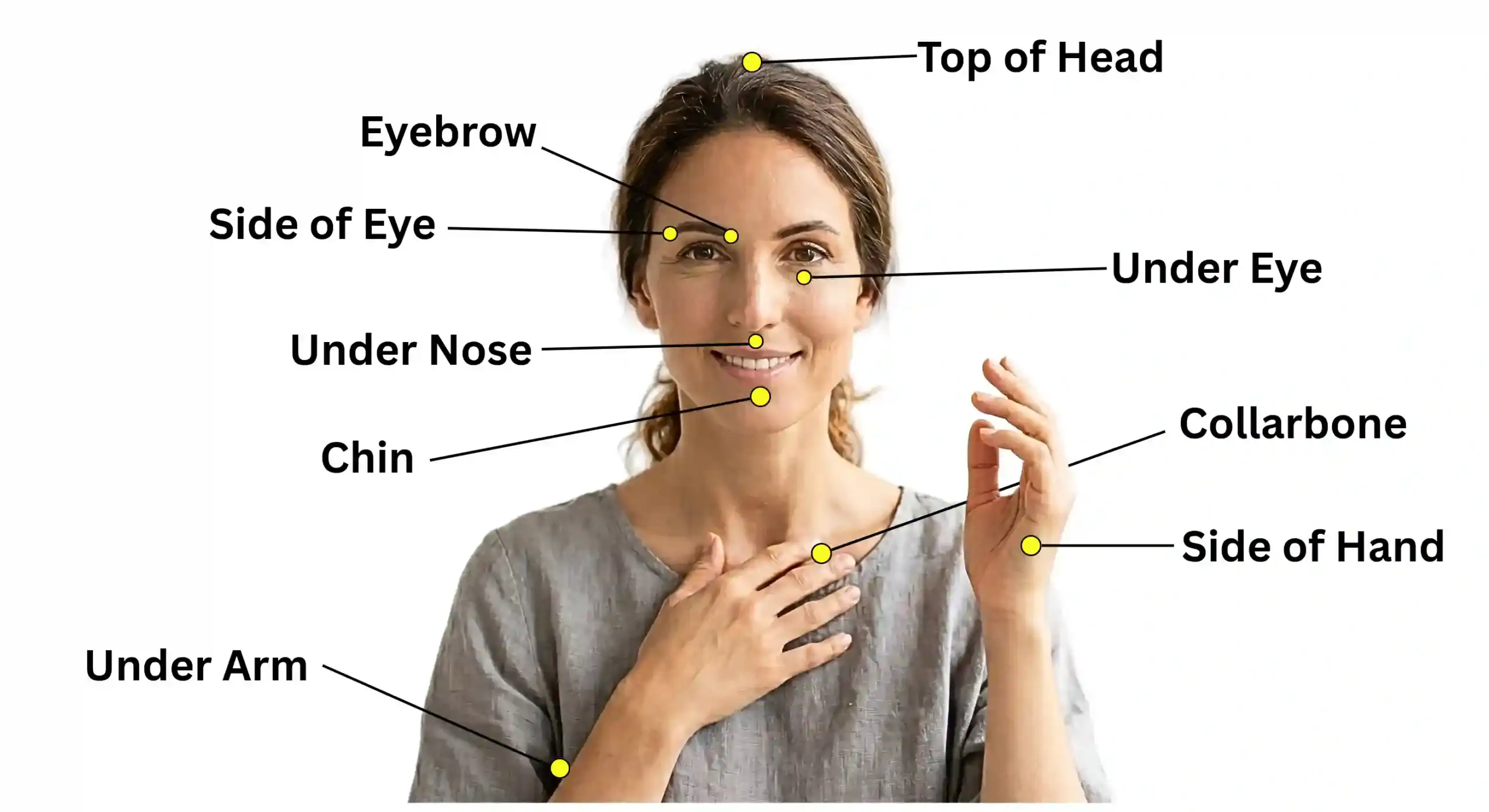
Common EFT tapping points include:
- Karate Chop (KC): The fleshy outer edge of the hand.
- Top of the Head (TH): Directly on the crown of the head.
- Eyebrow (EB): Where the eyebrows begin, nearest the bridge of the nose.
- Side of the Eye (SE): On the bone along the outside corner of the eye.
- Under the Eye (UE): On the bone directly under the eye.
- Under the Nose (UN): Between the bottom of the nose and the upper lip.
- Chin Point (CP): In the crease between your lower lip and chin.
- Collarbone (CB): Just below the ridge of the collarbone, about an inch down and out from the center.
- Under the Arm (UA): On the side of the body, about 4 inches below the armpit.
Tap each point about five to seven times before moving to the next one. You’re not counting precisely. You’re giving each spot a moment.
The order matters less than many beginners think. What matters most is staying focused on one issue and moving through the sequence with steady attention. For the traditional order and a step-by-step walk through each spot, see The 9 EFT Tapping Points in Their Traditional Order. If you’d like another clear breakdown, WebMD’s EFT tapping overview explains the points and the general process in simple terms, and Kaiser Permanente’s EFT page shows the standard areas as a diagram.
The Beginner’s EFT Tapping Sequence: A Step-by-Step Guide
- Pick one issue and rate its intensity from 0 to 10.
- Create a setup statement, such as, “Even though I feel this tension, I deeply and completely accept myself.”
- Tap the side of the hand while saying that setup statement three times.
- Tap through the main points while using a short reminder phrase, such as “this tension” or “this tight feeling.”
- Pause, take a breath, and rate the feeling again.
If “I deeply and completely accept myself” is more than you can say honestly today, use something smaller. “Even though this is here, I can be with myself right now” does the same job without asking you to perform a feeling you don’t have yet.
If the number drops, even a little, that’s useful. If it doesn’t, change the words so they fit what you’re truly feeling now.
Some of My Favorite EFT Teachers
If you want guidance, a few names come up again and again. Gary Craig is the central figure in modern EFT because he helped bring the method to everyday people. Many early students learned from his home-study materials, including the old DVD sets that introduced tapping step by step.
Brad Yates is widely known for warm, easy-to-follow guided tapping videos on YouTube. Nick and Jessica Ortner also helped bring EFT into the mainstream through books, interviews, events, and The Tapping Solution. If you want a broader professional view of the method and training standards, EFT International’s overview of EFT is a helpful starting point.
The teacher matters less than the fit. A calm voice, simple wording, and a pace that lets you breathe can make all the difference.
EFT Tapping FAQ
What is EFT tapping?
It’s a self-help method that combines light tapping on specific body points with focused thoughts, words, or feelings about a problem.
What does EFT stand for?
EFT stands for Emotional Freedom Technique.
Is EFT tapping the same as tapping therapy?
Usually, yes. Tapping therapy is a common nickname for EFT, whether done alone or with a practitioner.
How do you do EFT tapping?
You choose one issue, rate its intensity, say a setup statement, tap through the points, and then re-check how you feel.
What are EFT tapping points?
They’re the common spots used in a tapping round, including the side of the hand, eyebrow, side of eye, under eye, under nose, chin, collarbone, under arm, and top of head.
Does EFT tapping really work?
Many people say it helps them feel calmer and more grounded. Research also suggests it can reduce distress for some people, though results vary.
What is the science behind EFT tapping?
The science is still growing. Current studies suggest tapping may help calm the stress response, support nervous system regulation, and lower cortisol in some cases, but researchers still want more long-term data.
What is the Borrowing Benefits technique in EFT?
It is the process of tapping along with someone else’s emotional work. Even if you aren’t focusing on your own specific issue, the physical act of tapping helps lower your own stress levels.
Can EFT work even if I think it’s silly?
Yes. EFT is a body-based rhythm. Like the “physiological sigh”, it works on your nervous system regardless of whether you believe in it at first.
Is EFT the same as TFT?
Not exactly. EFT (Emotional Freedom Technique) is a simplified version of the earlier TFT (Thought Field Therapy) developed by Roger Callahan.
Does EFT tapping work for anxiety and overthinking?
Yes. By focusing on the physical sensation of the racing thoughts while tapping, you can interrupt the loop of overthinking and signal to your nervous system that it’s safe to come back to the present moment.
Can I do EFT tapping without words?
Absolutely. While naming the emotion is helpful, you can simply focus on the physical feeling in your body (like a tight chest or a lump in your throat) and tap through the points silently. This is often called silent tapping.
How long does it take for EFT tapping to work?
Many people feel a shift in intensity in as little as 2 to 5 minutes. However, deeper, more chronic issues may require consistent daily sessions over several weeks to create lasting change.
Why does EFT tapping make me yawn or cry?
Yawning, sighing, or even tears are often signs that your nervous system is shifting from fight or flight into a state of rest and digest. It’s a physical signal that your body is releasing stored tension.
EFT tapping isn’t about pretending life feels easy. It’s about meeting a hard moment with a little more steadiness, like placing one warm hand over a racing heart.
That’s why so many people keep coming back to it. The method is simple, the barrier is low, and even a short round can help you soften enough to hear yourself clearly.

About Vickie Barnes
Twenty years in, by way of Wayne Dyer, Abraham Hicks, and EFT trained on Gary Craig's original methods.
I write from inside a family where several people I love are managing hard things, so I'm not going to hand you "raise your vibration" as a solution. It does work. Just slower and plainer than the books promise.