

If you have ever felt stuck in worry, frustration, or fear, the Emotional Guidance Scale is a 22-step list of emotions from Abraham Hicks that can help you notice how you feel and gently shift toward something a little better. Not perfect. Just a little better. One small step at a time.
Some feelings are loud, some are quiet, and sometimes it can be hard to know where to begin, but this scale offers a soft place to start. Think of it like a map with breadcrumbs. You do not have to leap to joy right away. You only have to find the next possible step.
What Is the Emotional Guidance Scale?
The Emotional Guidance Scale is a 22-step hierarchy of emotions developed by Abraham Hicks (Esther Hicks). It helps individuals identify their current vibrational state and move incrementally toward higher-frequency emotions like joy, love, and appreciation.
The Emotional Guidance Scale is a chart of emotions used in Abraham Hicks teachings. If you would like a printable grid to work with, you can get the free Abraham Hicks Emotional Grid download.
At the bottom of the scale are the lower, heavier feeling emotions and escalates up to better feeling emotions landing at joy, love and appreciation.
The idea is simple. Your emotions are giving you information.
Not to judge you. Not to correct you. Just to help you notice where you are, so you can choose your next step with a little more care.
The Full Emotional Guidance Scale List
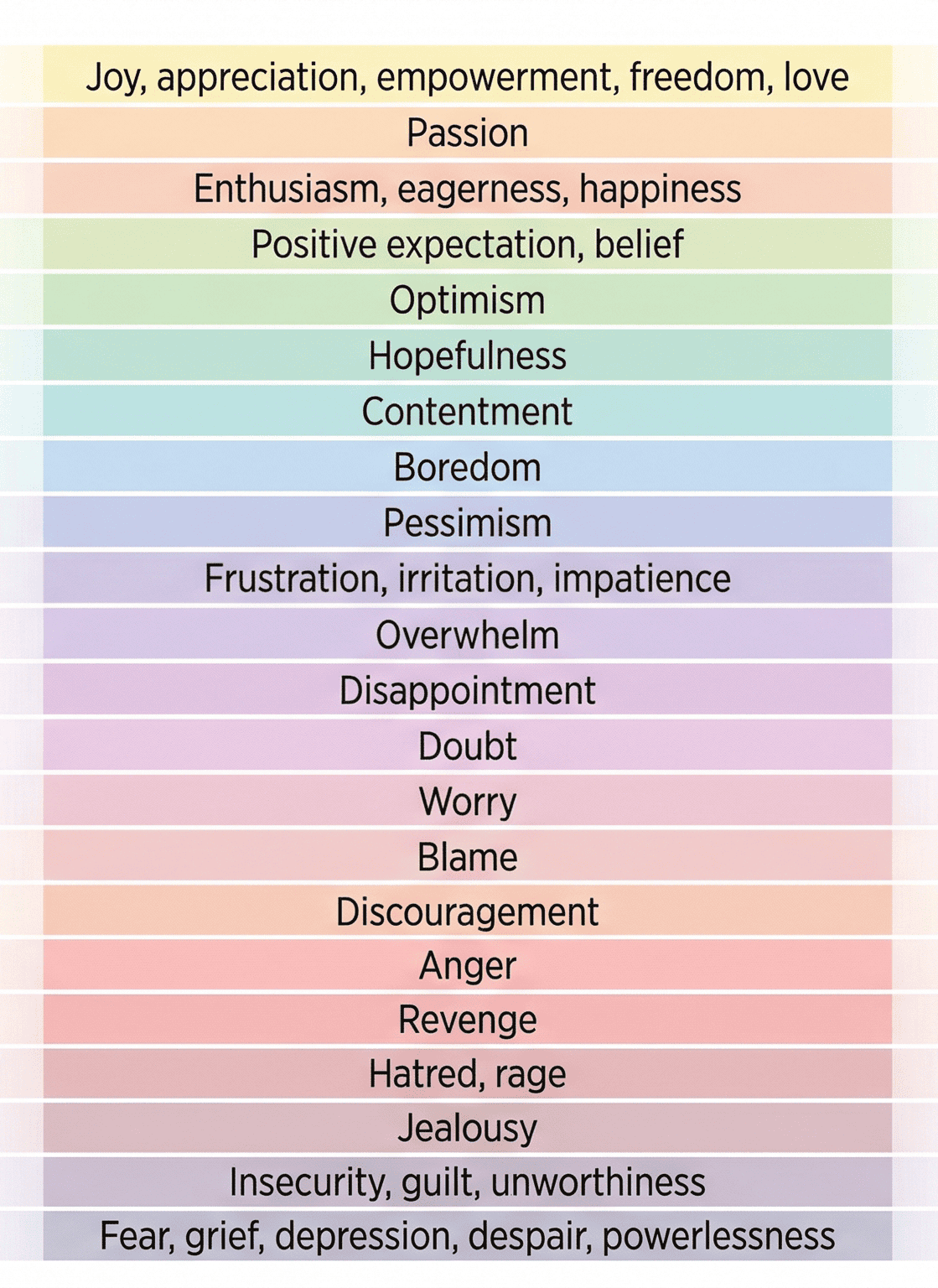
Here are the 22 emotions in the Abraham Hicks Emotional Guidance Scale, from highest to lowest:
Emotional Guidance Scale
| 1. | Joy, appreciation, empowerment, freedom, love |
| 2. | Passion |
| 3. | Enthusiasm, eagerness, happiness |
| 4. | Positive expectation, belief |
| 5. | Optimism |
| 6. | Hopefulness |
| 7. | Contentment |
| 8. | Boredom |
| 9. | Pessimism |
| 10. | Frustration, irritation, impatience |
| 11. | Overwhelm |
| 12. | Disappointment |
| 13. | Doubt |
| 14. | Worry |
| 15. | Blame |
| 16. | Discouragement |
| 17. | Anger |
| 18. | Revenge |
| 19. | Hatred, rage |
| 20. | Jealousy |
| 21. | Insecurity, guilt, unworthiness |
| 22. | Fear, grief, depression, despair, powerlessness |
If you have seen this called the Abraham Hicks emotional scale or the emotional guidance scale chart, it is the same thing.
How to Use the Emotional Guidance Scale in 5 Easy Steps.
Using the scale does not need to feel complicated.
In fact, it works best when it feels gentle.
- Pause and notice how you feel. Just name it. No fixing yet.
- Find your place on the scale. Are you in worry? Frustration? Boredom? Contentment?
- Look for the next feeling that is slightly better. Not perfect. Just a little softer.
- Reach for a thought that matches that feeling. A small shift can be enough.
- Move slowly.
There is no race here. This is more like following a trail of breadcrumbs home.
The scale is not asking you to fake positivity. It is inviting you to soften into the next possible step.
That may not sound dramatic. But honestly, that is often how real healing begins. Quietly. Kindly. One small shift at a time.
How to Move Up the Emotional Guidance Scale
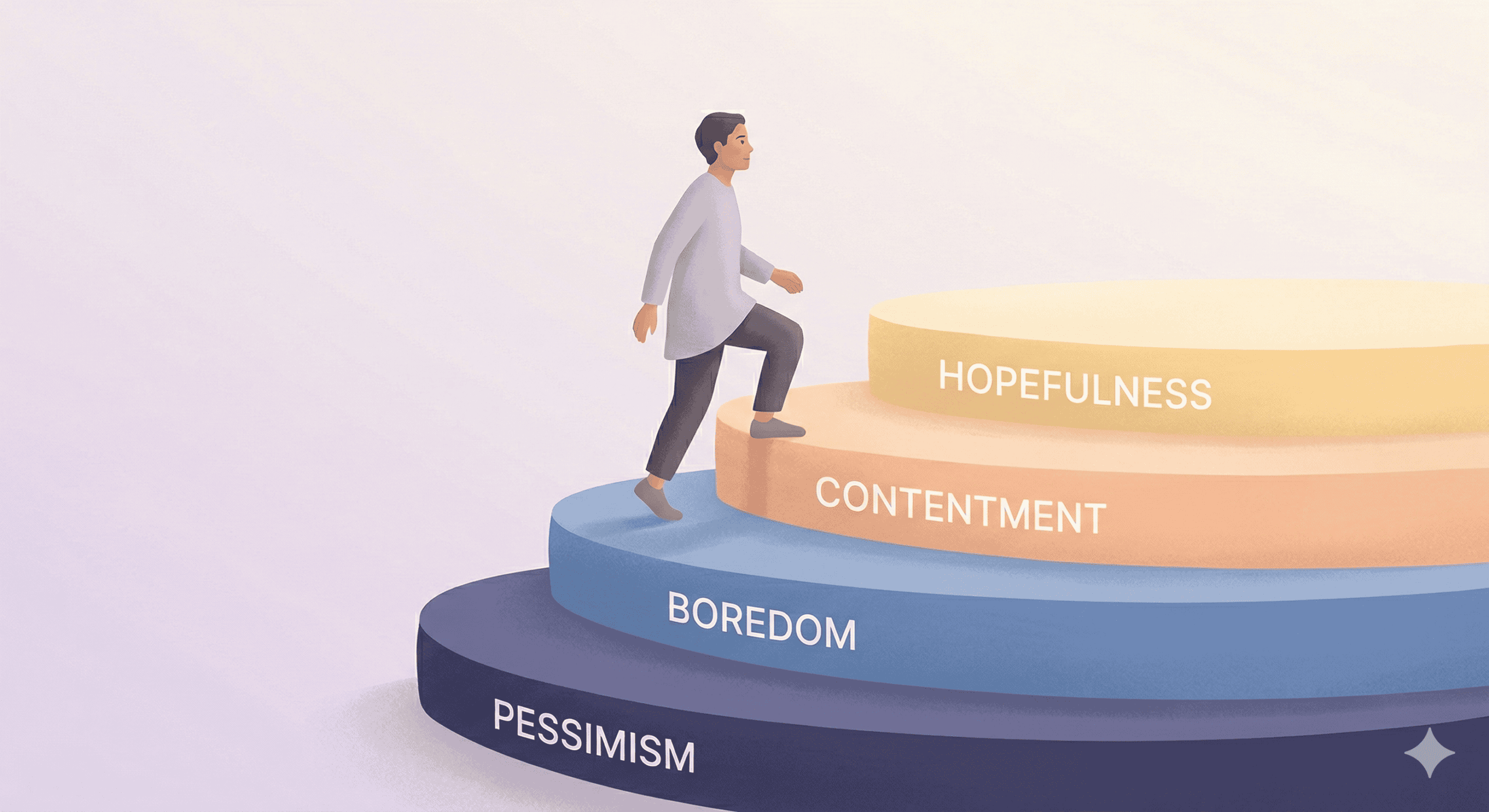
You do not usually move from fear to joy in one big leap. Most of the time, that is simply too much for a tender nervous system.
What helps more is a smaller move.
- From fear to worry
- From worry to doubt
- From doubt to hope
- From frustration to contentment
- From boredom to optimism
These are little steps, but little steps matter.
A little more breath. A little less pressure. A little more space around your thoughts. Sometimes that is enough to let the wall soften. If the next rung still feels out of reach, going general is often the way through.
Why Jumping Straight to Gratitude Doesn’t Work
Going from despair to joy in one leap is vibrational nonsense. Your system knows when a thought feels fake, and it will usually respond with, “Absolutely not.”
So if you’re sitting on the floor surrounded by unfolded clothes and mild despair, gratitude may not be the move. Relief is. A tiny bit of softening is. Even anger can be more useful than collapse, because at least anger has life in it.
Relief beats perfection. Every time.
What Each Part of the Scale Actually Feels Like
The list is useful, but it can feel abstract until you recognise yourself in it. Here is what the rungs tend to look like from the inside.
The bottom rungs: despair, powerlessness, and the numb zone
These states can look very ordinary. Doom scrolling for an hour. Staring at dishes like they personally betrayed you. Crying in secret, or feeling nothing at all, which is its own weird kind of exhaustion.
If that’s where you are, start tiny. Name it. Drink water. Stand outside for two minutes. Say, “This is where I am,” without adding a trial, a verdict, and a life sentence.
Why anger can be a promotion, not a failure
Here is the part people miss. Anger can be a vibrational promotion from despair or powerlessness. It can mean energy is coming back online. It can mean some part of you knows something is not okay. That ordering also says something about what the scale is really measuring, which I get into in the law of detachment.
That doesn’t mean yelling at strangers or rage-texting your ex. It means seeing anger as movement. Anger can say, “Actually, no.” That isn’t peace yet, but it is often a step toward self-protection.
The middle rungs: frustration to hope
Frustration gets a bad reputation, but it beats flatlined helplessness. Frustration has motion. It says, “I hate this,” which is still more alive than “Nothing matters.”
From there things can soften into maybe. Maybe this week won’t feel exactly like last week. Maybe I can do one thing. Maybe I can try again tomorrow with less drama and better snacks. That is how hope usually enters, not with fireworks, but with a quiet little crack in the wall.
The higher rungs: relief, calm, and feeling like yourself again
Relief is the real milestone. Not perfection. Not constant peace. Just that first exhale.
Sometimes relief looks boring, and that is excellent news. You take a shower. You answer one email. You fold two shirts from the laundry mountain. You notice the sky on the way to the car. Calm and appreciation may come later. For now, relief is already success.
Journaling Your Way Up the Scale
Why journaling works better than trying to think positive
Writing slows the whole train down. When a thought stays in your head it can feel huge and foggy at the same time. The page changes that. It gives the thought edges. Suddenly “everything is wrong” turns into “I am anxious about money and annoyed with my boss.” Still not fun, but at least now you’re dealing with something real.
Often the issue isn’t the feeling itself. It’s the inner tug of war. You want peace, but your mind keeps replaying the argument. You want more ease, but every bill makes your body brace. It’s like pressing the gas and the brake at the same time.
A journal helps you spot that friction without turning it into a character flaw. It also makes room for more believable thoughts. If “everything is working out perfectly” makes you roll your eyes, good. Your body is giving honest feedback. A better bridge might be “I don’t know how this will go yet.” That kind of thought doesn’t glitter. It doesn’t need to.
A step-by-step journaling practice
Keep this simple. A notebook, a notes app, or the back of a grocery receipt is fine. You don’t need to memorise all 22 rungs to find relief. Six small moves:
- Let your body arrive. Drop your shoulders. Unclench your jaw. Take a few slower breaths. If your mind is racing, drink water or stand up for a minute first. Sometimes the body loosens the mind.
- Name the feeling without editing it. Write one sentence: “Right now I feel…” Angry. Flat. Nervous. Jealous. Hopeful but tired. Precision helps.
- Ask what thought is feeding it. “What am I saying to myself right now?” Write the uncensored version. This is usually where you find the line that keeps poking the bruise.
- Find one rung up, not ten. If your thought is “Nothing ever works,” don’t jump to “My dream life is here.” Try “I don’t know that yet.”
- Use a bridge if you need one. “Wouldn’t it be nice if this eased up a little?” That phrase lowers the stakes. You’re allowing possibility, not forcing belief.
- End with one ordinary action. “What’s the next step that feels like a soft yes?” Usually it’s plain. Send one message. Tidy the counter. Rest for twenty minutes. If no action comes, that’s information too.
Journal prompts for moving one rung at a time
Your mind has favourite loops, and so does your body. This table is a starting point when you’re not sure where to begin:
| If you feel… | Try this softer thought | Journal prompt |
|---|---|---|
| Overwhelmed | “I only need to handle this moment.” | “What can wait until later today?” |
| Frustrated | “Something here could loosen.” | “What feels most tight right now?” |
| Doubtful | “I don’t have to believe every thought I think.” | “What seems possible, even a little?” |
| Sad | “I can be with this feeling without making it my whole future.” | “What would feel kind right now?” |
| Low or heavy | “I am allowed to seek comfort.” | “How can I lean toward appreciation?” |
Keep the next thought believable. If it makes your shoulders rise toward your ears, back up and go gentler.
A morning check-in often works best, because sleep tends to reset emotional momentum. Before your phone starts yelling at you, there’s usually a small window where your mind is quieter. Use it before the day starts collecting opinions.
A ten-minute daily practice
If you want structure, here’s a short routine that doesn’t require you to become a different person by breakfast.
- Two minutes: breathe and let your body settle. One hand on your chest if that helps.
- Three minutes: write exactly what you feel and what thought is attached to it.
- Three minutes: reach for one better-feeling thought. Use “Wouldn’t it be nice if…” when your brain is being dramatic.
- Two minutes: choose one next step that feels clear, kind, or relieving.
That’s enough for one day.
One place to be extra gentle: if journaling makes you feel more panicked, brings up trauma, or you’re dealing with depression, self-harm thoughts, or intense anxiety, this practice belongs next to mental health care, not instead of it. Support isn’t a spiritual failure. It’s support. A journal can help you hear yourself better. It can’t do every job.
What Climbing the Scale Actually Unlocks
Abraham has a name for everything you’ve already asked for and haven’t received yet. Vibrational escrow.
Every wish you’ve had didn’t evaporate when it failed to show up. A kinder job. A body that feels like home. One quiet morning to yourself. Abraham says it all goes into a kind of holding account, and nothing in there expires. It’s waiting on you to become a match for it.
That reframes the whole scale, at least for me. Climbing isn’t busywork, and it isn’t a test you keep failing. It’s what opens the account.
The entry requirement is also lower than it sounds. You don’t have to arrive at joy. You only have to stop broadcasting on the frequency of the problem. Despair to anger counts. Anger to frustration counts. Frustration to “well, maybe” absolutely counts.
Think of it like a radio. If frustration is what’s playing, you’re not tuned to the station where relief lives. You don’t have to love the new station. You only have to turn the dial.
So when you reach for the next best thought and nothing dramatic happens, that’s not a failure. That’s the dial moving.
Why the Emotional Guidance Scale Helps
This scale can be comforting because it gives your feelings a place to land.
Instead of asking, “Why am I like this?” in a harsh way, it gives you a softer question:
Where am I right now, and what feels a little better than this?
That is a powerful shift.
People often use the Emotional Guidance Scale to:
- understand their feelings more clearly
- calm emotional spirals
- feel less stuck
- find a next step when everything feels foggy
- practice self-awareness without pressure
It is not about becoming positive all the time. Let’s be real, that is not how humans work.
It is about noticing what is true, and then reaching for something kinder.
What Is the Purpose of the Emotional Guidance Scale?
The purpose of the Emotional Guidance Scale is to help you shift your emotions with more ease.
It does not ask you to push away difficult feelings. It does not ask you to pretend.
It simply offers a way to say, “This is where I am, and maybe there is one small step I can take from here.”
That next step might be tiny. That is okay.
Tiny still counts.
What Does the Emotional Guidance Scale Mean?
The Emotional Guidance Scale means that emotions can guide you instead of overwhelm you.
If a feeling is heavy, it may be asking for rest, compassion, or a gentler thought. If a feeling is lighter, it may be showing you that you are already moving in a steadier direction.
In a way, it is like checking the weather inside yourself.
You do not scold the storm. You notice it. You honor it. Then you choose what kind of care you need next.
What Emotion Is Highest on the Emotional Guidance Scale?
The highest emotion on the scale is joy, followed by appreciation, empowerment, freedom, and love.
These are the feelings that tend to feel open, peaceful, and expansive.
What Emotion Is Lowest on the Emotional Guidance Scale?
The lowest emotion on the scale is fear, grief, depression, despair, and powerlessness.
If you are there, please know this. You do not need to force yourself out of it all at once.
You can begin with one soft breath. One gentler thought. One tiny bit of support.
Can You Use the Emotional Guidance Scale If You Do Not Follow Abraham Hicks?
Yes, absolutely.
Even if you do not connect with Abraham Hicks teachings, you can still use the scale as a simple emotional check-in.
You can think of it as a way to notice your feelings, make sense of them, and gently move toward something that feels a little more aligned.
That is often enough to help.
FAQ
What is the Emotional Guidance Scale?
The Emotional Guidance Scale is a 22-step list of emotions used in Abraham Hicks teachings. It helps people notice how they feel and move toward a better-feeling emotion one step at a time.
What are the 22 emotions on the Emotional Guidance Scale?
The 22 emotions are joy, appreciation, empowerment, freedom, love, passion, enthusiasm, eagerness, happiness, positive expectation, belief, optimism, hopefulness, contentment, boredom, pessimism, frustration, irritation, impatience, overwhelm, disappointment, doubt, worry, blame, discouragement, anger, revenge, hatred, rage, jealousy, insecurity, guilt, unworthiness, fear, grief, depression, despair, and powerlessness.
How do you use the Emotional Guidance Scale?
Start by noticing how you feel now. Then look for the next emotion that feels a little better. The goal is to shift gently, not force a big change.
How do you move up the Emotional Guidance Scale?
You move up by choosing thoughts, actions, or focus points that feel slightly softer or more hopeful than where you are now.
Is the Emotional Guidance Scale from Abraham Hicks?
No, not exactly. The Abraham Hicks Emotional Guidance Scale is a specific 22-step scale used in Abraham Hicks teachings. Therapists and mental health professionals may use other emotional scales or feeling charts that are different from this one.
Do I need to memorize the entire 22-step scale to use this method?
No, you do not need to memorize every level of the scale to find relief. The primary goal is simply to identify where you are and reach for one thought that feels slightly better, regardless of its official position on the framework.
What should I do if I can’t find a better-feeling thought?
If you feel stuck, try using the phrase, “Wouldn’t it be nice if…” to lower the stakes and create a sense of possibility. If that still feels forced, simply prioritize rest or perform a small, non-demanding task to reset your emotional momentum.
Can journaling replace professional mental health support?
Journaling is a tool for self-awareness and should never replace professional therapy, especially if you are dealing with trauma, depression, or intense anxiety. If this practice ever increases your feelings of panic or distress, please set the journal aside and reach out to a qualified mental health provider for support.
A Small Takeaway
The Emotional Guidance Scale is really a kindness tool.
It reminds you that your feelings matter. Even the messy ones. Even the heavy ones. It helps you see that emotional change does not have to be dramatic to be real.
Sometimes the most meaningful shift is quiet.
A little less fear. A little more hope. A little more breath. A little more room to soften.
And if today feels hard, that is okay too. You do not have to solve everything right now. You only have to meet yourself where you are, with a little tenderness.
That is enough to begin.

About Vickie Barnes
Twenty years in, by way of Wayne Dyer, Abraham Hicks, and EFT trained on Gary Craig's original methods.
I write from inside a family where several people I love are managing hard things, so I'm not going to hand you "raise your vibration" as a solution. It does work. Just slower and plainer than the books promise.